Start up India
Startup India is an initiative of the Government of India to promote entrepreneurship in the country. The programme was first announced by Indian Prime Minister, Narendra Modi during his speech in 15 August 2015. The initiative is under the Ministry of Commerce and Industries (Department for Promotion of Industries and Internal Trade). The startup mission comprised (i) Simplification and Handholding, (ii) Funding Support and Incentives, and (iii) Industry-Academia Partnership and Incubation. According to the Economic Survey 2021-22, India has over 61,400 startups recognized by the Department for Promotion of Industry and Internal Trade (DPIIT), with at least 14,000 recognized during fiscal 2022. Startups in India have grown remarkably over the last six years. The number of new recognized startups has increased to over 14,000 in 2021-22 from only 733 in 2016-17.
Main Features:
- Initial capital of ₹20,000 crore (equivalent to ₹240 billion or US$3.2 billion in 2020) has been allocated for this scheme.
- Under this initiative, the government has already launched the I-MADE program, to help Indian entrepreneurs build 10 lakh (1 million) mobile app start-ups, and the MUDRA Bank’s scheme (Pradhan Mantri Mudra Yojana), an initiative which aims to provide micro-finance, low-interest rate loans to entrepreneurs from low socioeconomic backgrounds.
- India has become the third-largest startup ecosystem in the world after the US and China. A record 44 Indian startups achieved unicorn status in 2021, taking the overall tally of startup unicorns in India to 83, with most in the services sector.
- A startup defined as an entity that is headquartered in India, which was opened less than 10 years ago, and has an annual turnover less than ₹100 crore (US$13 million).
- A record 44 Indian startups achieved unicorn status in 2021, taking the overall tally of startup unicorns in India to 83, with most in the services sector.
- Recently Indian Prime Minister announced “India will celebrate January 16 as “National Start-up Day.”
Stand Up India
Stand Up India was launched by Government of India on 5 April 2016 to support entrepreneurship among women and SC & ST communities. Stand-Up India Scheme facilitates bank loans between 10 lakh and 1 Crore to at least one Scheduled Caste (SC) or Scheduled Tribe (ST) borrower and one woman.
Features:
The scheme requires that banks should give loan to at least one scheduled caste or one scheduled tribe and at least one woman entrepreneur per bank branch to set up a Greenfield enterprise.
The enterprise may be in manufacturing, services, agri-allied activities or the trading sector. In case of non-individual enterprise, at least 51 per cent share holding and controlling stake should be either an SC/ST or woman entrepreneur.
MUDRA
Pradhan Mantri MUDRA Yojana (PMMY) is a scheme launched on April 8, 2015 by Prime Minister of India Narendra Modi for providing loans up to 10 lakh to the non-corporate, non-farm small/micro enterprises.
Main Features:
- MUDRA stands for Micro-Units Development and Refinance Agency.
- MUDRA does not lend directly to the micro entrepreneurs / individuals. Mudra loans are given under Pradhan Mantri Mudra Yojana (PMMY).
- These loans are classified as MUDRA loans under PMMY.
- These loans are given by Commercial Banks, RRBs, Small Finance Banks, MFIs and NBFCs.
- Under the aegis of PMMY, MUDRA has created three products namely ‘Shishu’, ‘Kishore’ and ‘Tarun’ to signify the stage of growth / development and funding needs of the beneficiary micro unit / entrepreneur and also provide a reference point for the next phase of graduation / growth.
Sagarmala
- The Sagarmala Programme is the flagship programme of the Ministry of Shipping to promote port-led development in the country.
- Sagarmala aims to modernize India’s Ports, so that port-led development can be augmented and coastlines can be developed to contribute to India’s growth.
- It aims to exploit India’s 7,517 km long coastline, 14,500 km of potentially navigable waterways and its strategic location on key international maritime trade routes.
- It also aims at “transforming the existing Ports into modern world-class Ports and integrate the development of the Ports, the Industrial clusters and hinterland and efficient evacuation systems through road, rail, inland and coastal waterways resulting in Ports becoming the drivers of economic activity in coastal areas.”
- As part of Sagarmala Programme, more than 574 projects (Cost: Rs. 6.01 Lakh Cr.) have been identified for implementation, during 2015-2035, across the areas of port modernization & new port development, port connectivity enhancement, port-linked industrialization and coastal community development. As of 30-September-2019, a total of 121 projects (cost: Rs. 30,228 Cr) have been completed and 201 projects (cost: Rs.309, 048 Cr.) are under implementation.
- It entailed investing about ₹9.7 trillion (US$130 billion) in 2020 to set up new mega ports, modernizing India’s existing ports, developing of 14 Coastal Economic Zones (CEZs) and Coastal Economic Units, enhancing port connectivity via road, rail, multi-modal logistics parks, pipelines & waterways and promoting coastal community development.
- It eventually aims boosting merchandise exports by US$110 billion and generating around 10 million direct and indirect jobs.
Bharatmala
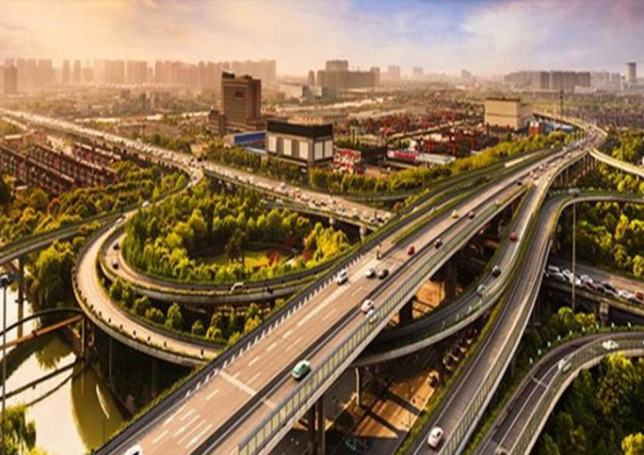
- The Bharatmala Pariyojana ((project) is a centrally-sponsored and funded Road and Highways project of the Government of India.
- The Project will interconnect 550 District Headquarters (from current 300) through a minimum 4-lane highway by raising the number of corridors to 50 (from current 6) and move 80% freight traffic (40% currently) to National Highways by interconnecting 24 logistics parks, 66 inter-corridors (IC) of total 8,000 km (5,000 mi), 116 feeder routes (FR) of total 7,500 km (4,700 mi) and 7 north east Multi-Modal waterway ports.
- The ambitious umbrella programme will subsume all existing Highway Projects including the flagship National Highways Development Project (NHDP), launched by the Atal Bihari Vajpayee government in 1998.
- The total investment committed for 83,677 km (51,994 mi) new highways is estimated at ₹5.35 lakh crore (US$71 billion), making it the single largest outlay for a government road construction scheme (as of December 2017).
- The project will build highways from Maharashtra, Gujarat, Rajasthan, Punjab, Haryana and then cover the entire string of Himalayan territories – Jammu and Kashmir, Himachal Pradesh, Uttarakhand – and then portions of borders of Uttar Pradesh and Bihar alongside Terai, and move to West Bengal, Sikkim, Assam, Arunachal Pradesh, and right up to the Indo-Myanmar border in Manipur and Mizoram.
- Under Bharatmala, Special emphasis will be given on providing connectivity to far-flung border and rural areas including the tribal and backward areas.
- It is both enabler and beneficiary of other key Government of India schemes, such as Sagarmala, Dedicated Freight Corridors, Industrial corridors, UDAN-RCS, BharatNet, Digital India and Make in India.
Industrial Corridor- An industrial corridor is a package of infrastructure spending allocated to a specific geographical area, with the intent to stimulate industrial development. An industrial corridor aims to create an area with a cluster of manufacturing or another industry. Such corridors are often created in areas that have pre existing infrastructure, such as ports, highways and railroads. These modalities are arranged such that an “arterial” modality, such as a highway or railroad, receives “feeder” roads or railways.
Industrial corridors of India include:
Gati Shakti Master Plan – On India’s 75th Independence Day, Prime Minister Narendra Modi announced that the Centre will launch ‘PM Gati Shakti Master Plan’, a Rs. 100 lakh-crore project for developing ‘holistic infrastructure’ Gati Shakti. It is a digital platform which envisages to bring 16 Ministries including Railways and Roadways together for integrated planning and coordinated implementation of infrastructure connectivity projects. It envisions 11 Industrial Corridors(Economic Corridors) to be developed by 2024-25.
The National Infrastructure Pipeline –The Prime Minister of India Narendra Modi announced the National Infrastructure Pipeline (NIP) during his 2019 Independence Day speech. NIP envisions developing several social and economic infrastructure projects in India over a period of five years. The initial sanctioned amount for the project was ₹102 lakh crore (US$1.4 trillion). India Investment Grid– In August 2020, the Union Minister for Finance and Corporate Affairs launched the India Investment Grid website which provides “Information on large-scale government infrastructure projects as an aid to investors, lenders and companies bidding for work. The grid is designed to give real-time updates on the implementation of the National Infrastructure Pipeline (NIP)
Dedicated Freight Corridor- The Dedicated Freight Corridor Corporation of India Limited (DFCCIL) is under the ownership of Indian Railways, Ministry of Railways, Government of India with the responsibility to undertake planning, development, and mobilisation of financial resources and construction, maintenance and operation of the “Dedicated Freight Corridors”(DFC). The DFCCIL was registered as a company under the Companies Act 1956 in 2006. First 2 DFCs, Western Dedicated Freight Corridor (WDFC), from Dadri (Uttar Pradesh) to JNPT in Mumbai and Eastern Dedicated Freight Corridor (EDFC), Ludhiana in Punjab to Dankuni in West Bengal, which will decongest railway network by moving 70% of India’s goods train to these two corridors, are both on track for completion by June 2022. 99% required land for these two have been acquired, and 56% of WDFC and 60% of EDFC is complete as of July 2020.
National Monetisation Pipeline (NMP)
- National Monetisation Pipeline (NMP) is Government of India’s monetisation framework for Government assets including roadways, railways and airports, power transmission lines, energy and renewable energy related assets, warehousing and sport-related assets.
- Roads, railways and power sector assets will comprise over 66% of the total estimated value of the assets to be monetised, with the remaining upcoming sectors including telecom, mining, aviation, ports, natural gas and petroleum product pipelines, warehouses and stadiums.
- In terms of annual phasing by value, 15% of assets with an indicative value of Rs 0.88 lakh crore are envisaged for rollout in the current financial year.
- The NMP will run co-terminus with the National Infrastructure Pipeline of Rs 100 lakh crore announced in December 2019. The estimated amount to be raised through monetisation is around 14% of the proposed outlay for the Centre of Rs 43 lakh crore under NIP.
- The assets on the NMP list include: 26,700 km of roads, railway stations, train operations and tracks, 2,8608 Ckt km worth of power transmission lines, 6 GW of hydroelectric and solar power assets, 2.86 lakh km of fibre assets and 14,917 towers in the telecom sector, 8,154 km of natural gas pipelines and 3,930 km of petroleum product pipelines. In the roads sector, the government has already monetised 1,400 km of national highways worth Rs 17,000 crore. Another five assets have been monetised through a PowerGrid InvIT raising Rs 7,700 crore.
- Further, 15 railway stations, 25 airports and the stake of central government in existing airports and 160 coal mining projects, 31 projects in 9 major ports, 210 lakh MT of warehousing assets, 2 national stadia and 2 regional centres, will be up for monetisation. Redevelopment of various government colonies and hospitality assets including ITDC hotels is expected to generate Rs 15,000 crore.
Atmanirbhar Bharat
- Atmanirbhar Bharat or ‘self-reliant India’, is an economic vision of the Government of India to promote economic development in the country by using its own technology, natural and human resources to reduce its dependence on the rest of the world. The vision also aims at developing India’s own internal value chain and also to be a centre of global value chains.
- It is not protectionism. It is not inward looking. It is not just import substitution and it is not economic nationalism.
- Atmanirbhar Bharat) will “make India self-reliant by creating an eco-system that will allow Indian companies to be highly competitive on the global stage”. The key element here is the “need to create an eco-system” that will allow Indian companies to be globally competitive and thus making India self-reliant.
- The AB vision aims at pursuing policies that are efficient, competitive and resilient, that encourage equity, and being self-sustaining and self-generating.
- As a first step, the government has come out with performance-linked incentive (PLI) schemes for sectors that are extensively import dependent. This should help India build the supply-chain within the country for products that are critical in the future — electronic products (including mobile phones) and active ingredients for the pharmaceutical sectors, to name a few.
AzadIi ka Amrut Mahotsava
- Azadi Ka Amrit Mahotsav is an initiative of the Government of India to celebrate and commemorate 75 years of independence and the glorious history of its people, culture and achievements.
- The official journey of Azadi ka Amrit Mahotsav commenced on 12th March 2021 which started a 75-week countdown to our 75th anniversary of independence and will end post a year on 15th August 2023.
- This Mahotsav is dedicated to the people of India who have not only been instrumental in bringing India thus far in its evolutionary journey.
- It also aligns with the vision of activating India 2.0, fuelled by the spirit of Aatmanirbhar Bharat.