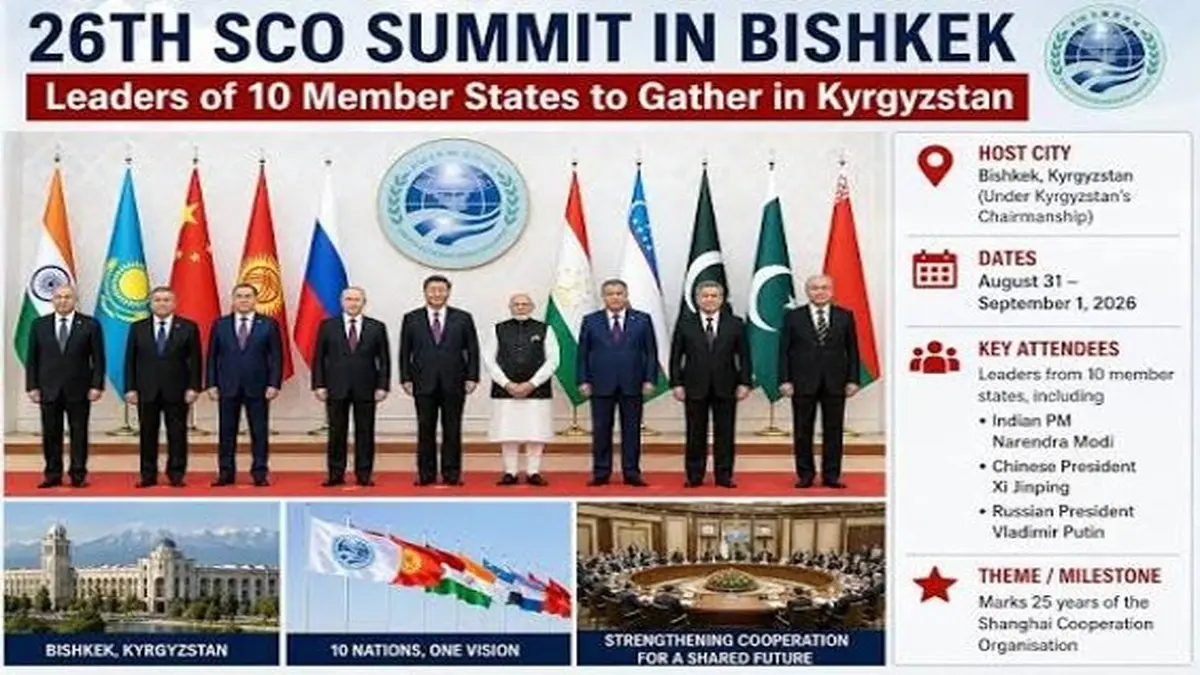
The 26th Shanghai Cooperation Organisation (SCO) Summit in Bishkek concluded with the adoption of the historic Bishkek Declaration and 13 key outcomes focusing on security, counter-terrorism, and regional cooperation. The SCO is a Eurasian political, economic and international security organisation of ten member states. It is the world’s largest regional organisation in terms of geographic scope and population, covering at least 24% of the world’s total area (65% of Eurasia) and 42% of the world population. As of 2024, its combined nominal GDP accounts for around 23%, while its GDP based on PPP comprises approximately 36% of the world’s total.
The SCO is the successor to the Shanghai Five, formed in 1996 between China, Kazakhstan, Kyrgyzstan, Russia, and Tajikistan. The leaders of these nations and Uzbekistan met in Shanghai and announced the creation of SCO in June 2001 with an objective of deeper political and economic cooperation. In June 2017, it expanded to eight states, with India and Pakistan. Iran joined the group in July 2023, and Belarus in July 2024. Several countries are engaged as observers or dialogue partners.
Key Outcomes and Decisions
The 26th Shanghai Cooperation Organisation (SCO) Summit in Bishkek concluded with 13 key outcomes. The outcomes covered counter-terrorism, climate action, energy, disaster management and digital cooperation.
After the 26th SCO meet the members issued a Bishkek Declaration which shared positions on Eurasian stability, regional development, and sovereignty-based connectivity. Terrorism, extremism and transnational organized crimes remained an important focus of the meet and the members approved regulations to establish a new body i.e. Universal Centre for Countering Security Threats to strengthen joint responses against these perplexing issues.. As drug and narcotics supply in the region is increasingly being seen as a common problem faced by all the members, they decided to improve Anti-Narcotics Coordination for approving regulations for the executive committee of the SCO Anti-Narcotics Centre, alongside action plans up to 2030 to combat synthetic drugs and drug addiction. Other important outcomes include an agreement to officially include English as an official working language of the SCO, adoption of a memorandum on combating climate change and an agreement to boost energy conservation, efficiency, and security and expanded digital sector collaboration to include artificial intelligence and information sharing. The members also adopted a joint statement on humanitarian assistance and emergency aid for affected countries during disaster.
India’s Stance and Highlights
Prime Minister Narendra Modi emphasized a zero-tolerance policy against cross-border terrorism, stating there can be no double standards or use of extremist proxies as state policy. Indian PM stressed that dialogue and diplomacy are the sole solutions to ongoing international conflicts, including those in Russia-Ukraine and West Asia. He also highlighted practical economic connectivity, digital public infrastructure cooperation, and people-centric partnerships.