
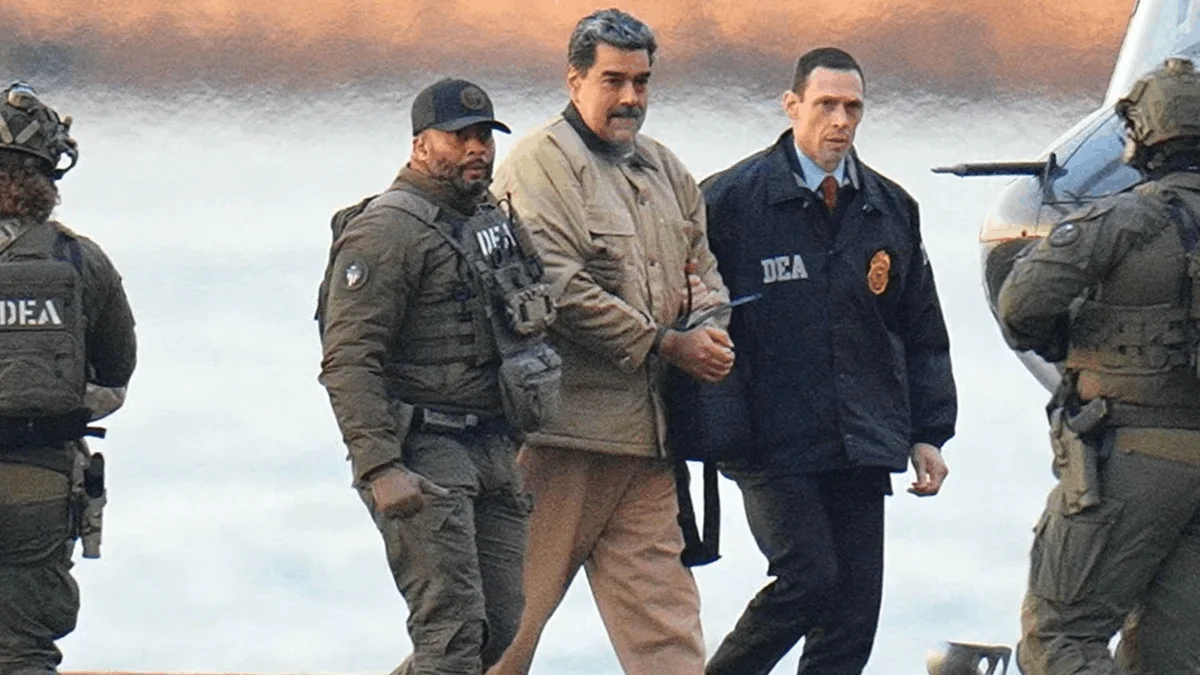
U S forces captured Venezuelan president Nicolás Maduro and his wife, Cilia Flores on January 3, 2026 in a swift and large-scale military operation named Operation Absolute Resolve in Caracas on the allegation of . narco-terrorism and drug trafficking, Later they were taken in federal custody in New York o face indictment. Following months of intelligence tracking by U.S. forces, elite Delta Force troops breached Maduro’s Caracas compound in the early morning. Maduro and Flores were extracted without a prolonged standoff and flown to the USS Iwo Jima before being transferred to the United States.
The event marked a huge geo-political event, albeit local in nature, but indicating a new geo-political order in which a mighty nation could take action against a sovereign nation’s head of state and capture him for trial without caring for international laws and procedures in such cases. Subsequently Vice president of the country Delcy Rodríguez was sworn in as interim/acting president. On January 5, 2026, Maduro and Flores pleaded not guilty to U.S. federal charges in Manhattan. The Justice Department’s indictments allege they presided over a “narco-state” and conspired to import cocaine.
The U.S. action drew varied responses, featuring celebrations among the Venezuelan diaspora, widespread release of political prisoners, but also significant international debate regarding national sovereignty and international law. One of the reasons for a regime change of Venezuela by the US by force is US intent to cut Venezuala’s energy supply to China The United States has moved to integrate Venezuela’s petroleum assets into North American energy networks. Notably, Venezuela holds the world’s largest proven crude oil reserves, with approximately 303 billion barrels.
The administration in Washington has established a transition plan to reopen the Venezuelan oil sector to private and foreign investment. The U.S. is seeking to rebuild Venezuela’s heavily degraded infrastructure and harmonize the Western Hemisphere’s energy network under the “Donroe Doctrine”. Washington has directed immediate shipments of Venezuelan oil to the U.S.. Tanker seizures and blockades have redirected global supply flows, significantly altering prior trade dependencies with countries like China. However, US plan would face challenges in exploiting Venezuela’s massive oil reserves as the crude is thick, rich in sulfur and heavy which would require advanced upgrading and refining techniques with an estimated cost of $100 billion to fully restore Attachments area.
The event is being seen as Donald Trump’s attempt to establish U S hegemony by use of coercive methods. The American president has already expressed an intent to take back and rename Panama Canal, Canada as 51st state of U S and take Greenland under his control from Denmark. These designs are contrary to international laws and conventions on preservation of sovereignty of nations. Such U S designs have drawn wide criticisms as they indicate emergence of a new coercive and might based geo-political order marked by an unbridled desire of a nation to establish hegemony on other nations in utter disregard of their sovereignty. Such interference does not auger well for a peaceful world order.