
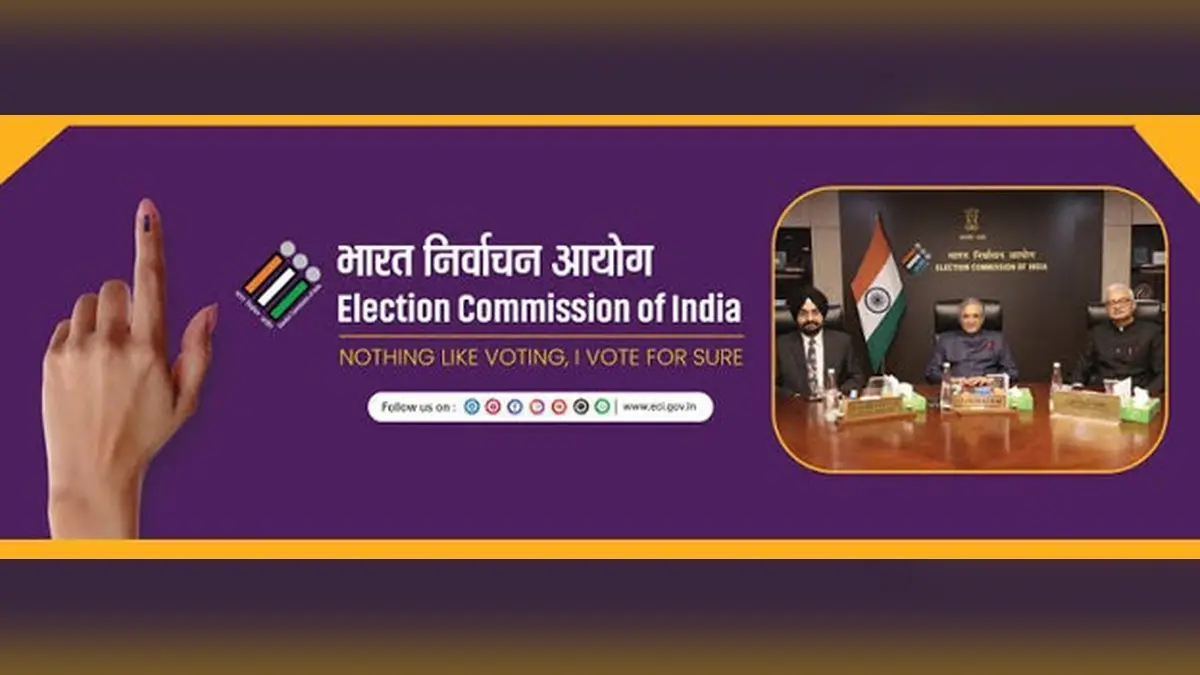
India is a Socialist, Secular, Democratic Republic and the largest democracy in the World.. It has not only weathered and survived all the crises in past, but also built institutions and conventions to nurture and protect democracy. The Indian democracy is a multi-party polity with universal adult franchise. The constitution of India, thus treats “we the people” as real sovereigns. Elections in India are conducted by the election Commission of India.
The Constitution of India has vested in the Election Commission of India the superintendence, direction and control of the entire process for conduct of elections to Parliament and Legislature of every State and to the offices of President and Vice-President of India. The Election Commission was established in accordance with the Constitution on 25th January 1950..It is a permanent Constitutional Body. Originally the commission had only a Chief Election Commissioner. It currently consists of Chief Election Commissioner and two Election Commissioners.
The present Chief Election Commissioner (CEC) of the Election Commission of India is Gyanesh Kumar and other two Election Commissioners are Sukhbir Singh Sandhu and Vivek Joshi. Currently, the Election Commission of India (ECI) is facing major controversies surrounding the Special Intensive Revision (SIR) of electoral rolls, internal dissent among election commissioners, and accusations of political bias.
Key Controversies and Issues
- Special Intensive Revision (SIR) and Voter Deletions: The nationwide SIR process led to the removal of approximately 130 million (13 crore) names from voter lists and draft rolls. Opposition parties, including the Congress and the Cockroach Janta Party (CJP), have criticized the exercise as exclusionary, alleging that it places an unfair burden on citizens to prove eligibility and results in wrongful disenfranchisement.
- Internal Dissent Among Commissioners: Reports surfaced that fellow Election Commissioners Sukhbir Singh Sandhu and Vivek Joshi formally recorded objections on at least 14 occasions over a 10-month period. They questioned Gyanesh Kumar regarding unilateral decision-making, centralization of voter database access, and changes to enrollment forms without prior collective consultation.
- Allegations of Political Bias and “Match-Fixing”: Opposition leaders such as Rahul Gandhi and Mamata Banerjee have accused the ECI of favoring the ruling party (BJP), demanding Gyanesh Kumar’s resignation or legal action. These claims follow sharp exchanges between the ECI and political delegations (such as the Trinamool Congress during the West Bengal assembly elections) and public statements perceived as partisan.
- Legal Challenges in the Supreme Court: The Supreme Court agreed to an early listing of petitions challenging the validity of the SIR process, the functioning of the poll panel, and decisions made under Gyanesh Kumar’s leadership.
The opposition protest is gathering momentum and they will conduct rallies during October 2 -10 throughout the nation with their demands pertaining to reforms in the election commission to safeguard voters’ interest. Meanwhile, the Election Commission rejected allegations of political manipulation or illegal unilateralism. It maintained that differing views and internal observations are a normal part of institutional deliberations and that final orders—including those tied to the SIR—received unanimous approval. Also the ruling BJP dismissed the opposition’s resignation demands and criticism as a politically motivated smear campaign designed to undermine independent constitutional bodies.
In the biggest democracy of the world the credibility of the election commission would eventually depend on fair conduct of elections and efforts to safeguard voters’ rights. The beauty of Indian democracy is that all the citizens irrespective of their socio-economic status and caste, religion and religion have right to vote. It needs to be maintained at all costs. In this regard a vigilant citizenship is also very important.