
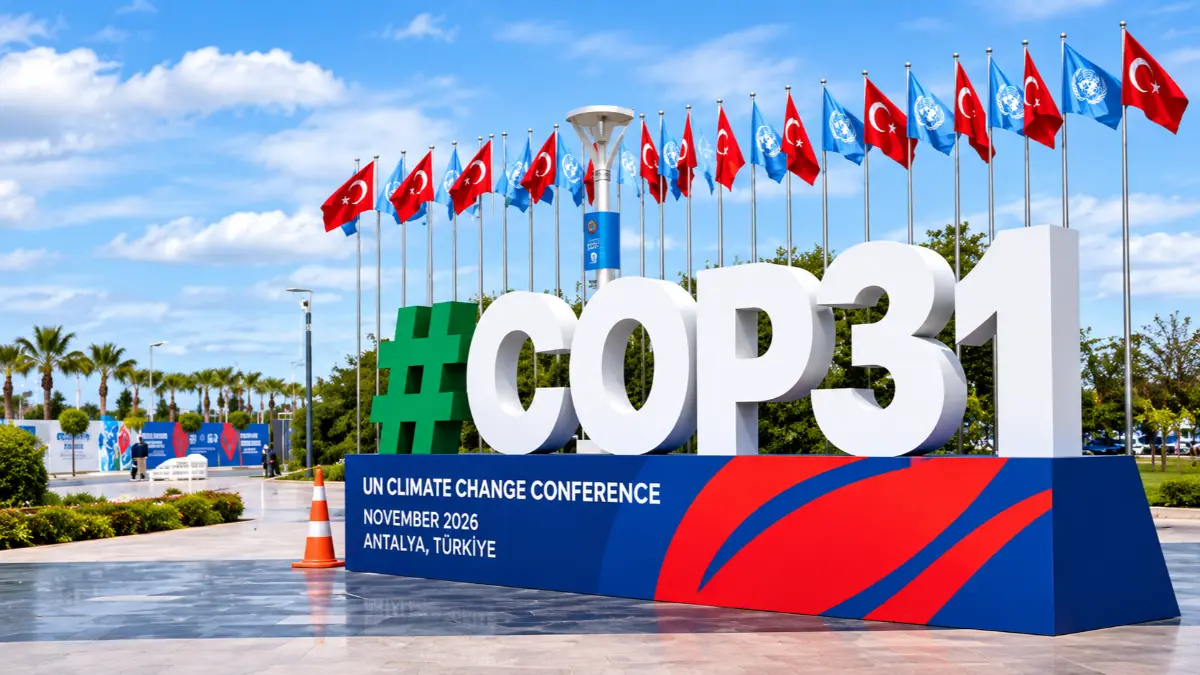
Why in news
The 31st Conference of the Parties (COP31) to the UN Framework Convention on Climate Change (UNFCCC) is being held at the Antalya Expo Center in Antalya, Türkiye, from 9 to 20 November 2026. After a week of technical negotiations, the talks have moved to the ministerial stage. Reports from Antalya describe the first week as having ended without agreement on fossil fuels, with climate finance also dividing developed and developing countries.
An unusual shared leadership
COP31 has a split arrangement that came out of a compromise between Türkiye and Australia, both of which wanted to host. Türkiye is the host and holds the COP Presidency through Murat Kurum, its Minister of Environment, Urbanisation and Climate Change, and is responsible for the Action Agenda. Australia’s Climate Change and Energy Minister Chris Bowen is the President of Negotiations and chairs the formal talks. A World Leaders’ Summit was held on 11 and 12 November.
The background
The UN Environment Programme’s Emissions Gap Report 2026 projects warming of about 2.6°C this century even if all current national pledges are fully implemented, far above the Paris Agreement goals of well below 2°C and efforts towards 1.5°C. COP29 in Baku (2024) set a new climate finance goal of 300 billion dollars a year by 2035 from developed countries, which developing countries considered inadequate. COP30 was held in Belém, Brazil in 2025. Antalya is therefore seen as an “implementation” COP, expected to show that earlier promises can be delivered.
Main issues on the table
- Climate finance: developing countries want a dedicated discussion on Article 9.1 of the Paris Agreement, which obliges developed countries to provide finance. A new Climate Finance Work Programme is under negotiation, with old disagreements over who should pay.
- Fossil fuels: major producers and several large consumers are resisting firm new language on moving away from coal, oil and gas.
- Adaptation: indicators under the Global Goal on Adaptation and funding for resilience.
- Cover decision: the main political text; the Presidency is also promoting voluntary pledges such as the “35 by 35” goal and an electrification pledge.
India’s position
- India is seeking a formal decision to launch the Climate Finance Work Programme and insists that finance is an obligation of developed countries.
- It wants adaptation indicators to remain voluntary so that they do not become conditions for getting finance.
- It opposes new emission obligations and has declined to support a fossil-fuel phase-out, citing its energy needs.
- It opposes the European Union’s Carbon Border Adjustment Mechanism (CBAM) as a unilateral trade measure.
- It wants the Presidency’s voluntary initiatives kept separate from the formal negotiations.
- India co-chairs the mitigation consultations with Germany, and is holding LeadIT 3.0 with Sweden. India’s opening statement was delivered on 10 November by Environment Secretary Narendra Bhooshan; Environment Minister Bhupender Yadav had outlined the approach in New Delhi on 3 November.
Significance
The outcome will test whether multilateral climate diplomacy can still deliver when trust between the global North and South is low. For India the stakes are policy space for development, predictable finance and technology, and protection against trade measures taken in the name of climate.
Points to remember
- COP31: Antalya, Türkiye, 9–20 November 2026
- COP President: Murat Kurum (Türkiye); President of Negotiations: Chris Bowen (Australia)
- COP30: Belém, Brazil (2025); COP32: Addis Ababa, Ethiopia (2027)
- UNFCCC adopted in 1992; Paris Agreement adopted in 2015
- CBDR-RC: common but differentiated responsibilities and respective capabilities