
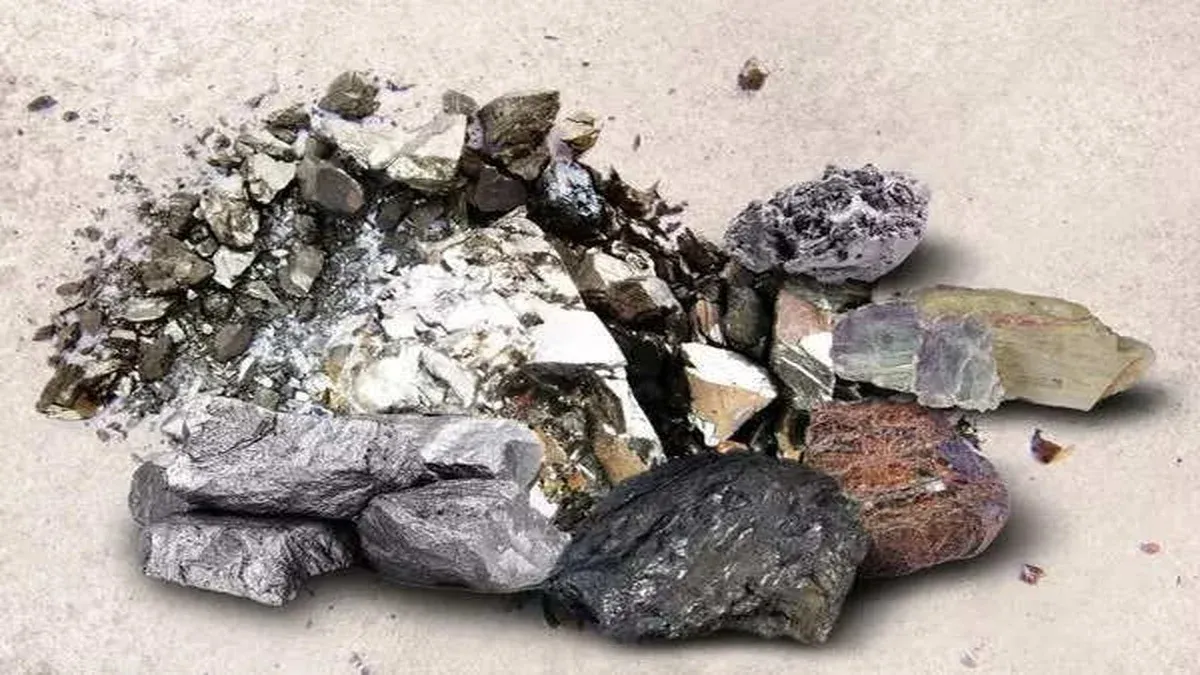
What is meant by critical minerals?
Critical minerals are natural raw materials of high strategic importance to the economy and national security. These are needed in nearly every new technology based products such as -smartphones and electric vehicles (EVs), renewable energy systems and advanced medical equipment. These minerals are defined as “critical” because they are vital for economic activity. but they face significant supply risks. This vulnerability stems from the fact that their extraction and refining are concentrated in a handful of countries. As of 2025, the critical minerals list includes 60 minerals, including Magnesium, Phosphate, Potash, Copper, Lithium, Cobalt, Nickel, Graphite, Gallium, and Germanium. It also features numerous Rare Earth Elements (REE)-17 elements with unique properties that serve as core components in various systems, such as Neodymium and Dysprosium. The list of critical minerals constantly evolves.
What is meant by rare earths?
Rare earths (or rare-earth elements) are a group of 17 chemically similar metallic elements: the 15 lanthanides on the periodic table, plus scandium and yttrium. Despite their name, they are relatively abundant in the Earth’s crust, but are rarely found in concentrated, easily minable deposits. Because of their unique magnetic, luminescent, and electrochemical properties, these elements are essential for modern technology and the global energy transition.
Production and processing of critical minerals and rare earths
China overwhelmingly dominates the global production and processing of critical minerals and rare earths, controlling approximately 60% of mining and over 85% to 90% of globalprocessing capacity. Beijing frequently leverages this near-monopoly—spanning everything from electric vehicle (EV) batteries to defense technologies—for geopolitical leverage.While China controls the refining and mid-stream processing, the upstream mining of raw materials is distributed among a few other key players including Australia and Democratic republic of Congo (DRC).. Australia is a powerhouse in raw extraction and world’s leading producer of raw lithium and also mines significant amounts of rare earths. On yhr other hand DRC controls the majority of global cobalt production, an essential material for most EV and renewable energy batteries. Notably, there are other countries which have begun heavily investing in domestic processing infrastructure and building local, high-value manufacturing ecosystems, even by resorting to export bans. Malaysia, for example is one of the largest processors of rare earth elements outside of China. Vietnam holds the second-largest rare earth deposits globally, India has world’s third-largest rare earth reserves. Both the countries are trying to build their own resilent domestic supply chains. Vietnam government has instituted strict state management and export bans on raw ores to develop domestic processing. on the other hand India is heavily expanding its refining capacity through dedicated “rare earth corridors” and a scheme for high-performance magnets. In South Americ Brazil and Argentina are key players for raw materials (such as lithium and ionic clay rare earths) who are actively securing investments to build out their own mid-stream processing chains.
Global Counter strategies
China uses its dominance in rare earths as an instrument of diplomatic leverage on one hand and a tool for maintaining its comparative advantage in emerging industries and advanced manufacturing. It has resorted to various restrictions on exports of rare earths through a series of sweeping licensing requirements and extraterritorial regulations on critical minerals, dual-use technologies, and magnets..
In view of overarching dominane of China in production and processing of critical minerals and rare earths, advanced nations including US, Japn and EU are adopting counter-Strategies and entering into alliances to build a resilient and reliable supply chain for their own industrie. Western and allied nations have rapidly formed alliances (such as the Minerals Security Partnership) to diversify supply chains and fund localized extraction and purification projects.In this regard US and Canada deserve special reference. Both possess critical mineral reserves (e.g., U.S. Mountain Pass in California and Canadian heavy rare earths) and are channeling billions into reviving domestic ore purification and refinery pipelines. Japan although lacksdomestic reserves, it maintains deep strategic stockpiles of refined rare earths and has forged bilateral processing agreements with the U.S. and Australia.
The US is also aggressively pursuing critical minerals and rare earths alliances in Central Asia to counter China’s near-monopoly on supply chains. Leveraging diplomatic summits, US-led partnerships, and massive development financing, Washington seeks to secure untapped reserves of uranium, antimony, gallium, and copper while reducing reliance on Beijing. To catalyze private sector involvement, the US approved over $2 billion in Development Finance Corporation (DFC) funding designated for supply chain security and regional mineral projects. For the Central Asian republics, aligning with the US offers vital economic investment and an opportunity to modernize their refining industries while maintaining strategic neutrality between Russia and China. The US C5+1 Critical Minerals Dialogue connects the U.S. with Kazakhstan, the Kyrgyz Republic, Tajikistan, Turkmenistan, and Uzbekistan with an aim to map regional resources, improve geological data sharing, and diversify supply chains away from China.