
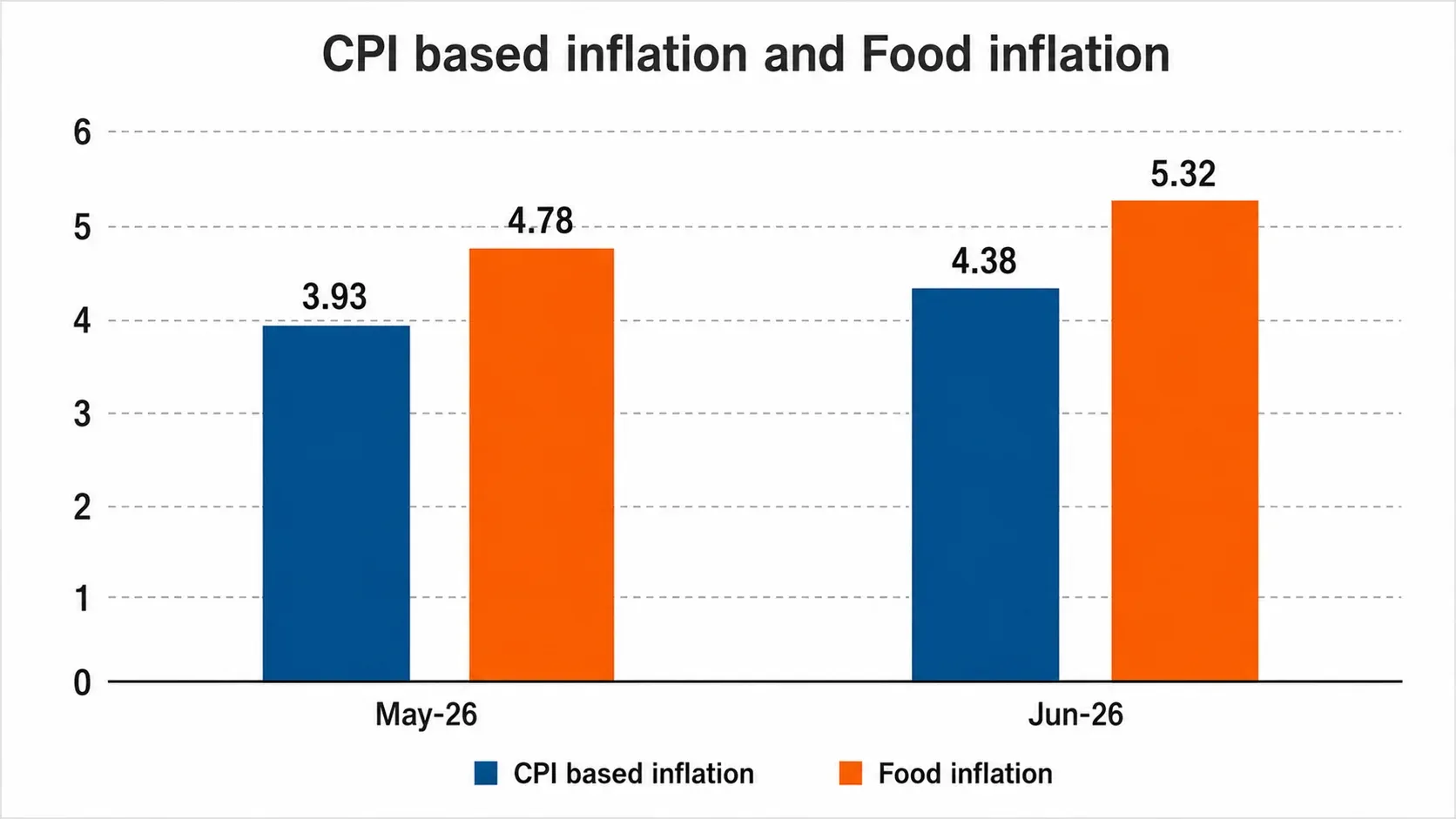
Year-on-year inflation rate based on All India Consumer Price Index (CPI) with base year 2024 for the month of June, 2026 over June, 2025 is 4.38% (Provisional), marking a 17-month high. Corresponding inflation rates for rural and urban are 4.74% and 3.92%, respectively. Wholesale price inflation rose to 9.87% in June, from 9.68% in May, led by a sharp spike in prices of non-food and food products.The latest wholesale price index (WPI) inflation data is based on the 2022-23 base year. As per the data, food inflation rose to 5.49% in June, from 3.60% in May, as food prices rose during the month following a rainfall deficit due to the El Niño impact. Non-food articles WPI inflation was also higher at 11.07% , while in minerals it was 9.45% in June.
Mineral Oils (containing Petroleum Products), Food Articles, Manufacture of Basic Metals, and Manufacture of Chemicals and Chemical Products have been major drivers of WPI inflation in June 2026. WPI inflation in fuel and power was down to 27.41% in June, from a peak of 30.33% in May. In manufactured products, inflation was unchanged at 7.48 per cent as in May. Global commodity prices and crude oil prices had taken a breather in June with the truce announcement between the US and Iran. This was reflected in lower fuel and power WPI inflation.
Mesurement of Inflation in India
Inflation is the increase in the prices of goods and services over time. It is a general increase in the overall price level of the goods and services in the economy rather than movement in price of any single product. The movement in overall price level is measured by a basket of goods and services.
There are two important measures of inflation in India – Consumer Price Index (CPI) and Wholesale Price Idex (WPI). The Consumer Price Index (CPI) measures retail inflation by collecting data on the prices of goods and services that are consumed by consumers. It measures the average change in prices paid by consumers over time for a basket of goods and services. The National Statistical Office (NSO), under the Ministry of Statistics and Programme Implementation (MoSPI), publishes the headline Consumer Price Index (CPI Combined)) along with CPI rural and CPI urban. . Thus, the: official headline inflation measures retail inflation i.e., price changes of a basket of goods and services across both rural and urban areas. It is used by the Reserve Bank of India (RBI) for monetary policy and inflation targeting.The WPI on the other hand tracks price changes at the producer/wholesale level across three primary commodity groups: Primary Articles, Fuel and Power, and Manufactured Products. In India WPI is calculated by. Office of Economic Advisor (OEA), Department for Promotion of Industry and Internal Trade (DPIIT), Ministry of Commerce and Industry and compiled on a monthly basis,.
The CPI in India, published by the Ministry of Statistics and Programme Implementation ((MoSPI) tracks retail price changes for a fixed basket of 358 items divided into 12 major groups based on international consumption standards. The MoSPI revised the base year for the Consumer Price Index (CPI) in India to 2024 (2024=100), replacing the previous base year of 2012. The updated series was officially introduced in February 2026. The Ministry of Statistics and Programme Implementation (MoSPI) officially transitioned to this revised base year to accurately reflect contemporary household consumption patterns.
Additionally, the Labour Bureau (part of the Ministry of Labour and Employment) publishes specific CPI variations such as CPI for Industrial Workers (CPI-IW) and CPI for Agricultural/Rural Labourers (CPI-AL/RL).
- CPI for Industrial Workers (CPI-IW): Tracks inflation for industrial workers and is primarily used by the government to calculate the Dearness Allowance (DA) for central and state employees.
- CPI for Agricultural Labourers (CPI-AL): Measures the cost of living and inflation changes specifically for agricultural workers in rural areas, used to help fix minimum wages.
CPI for Rural Labourers (CPI-AL/RL): Similar to CPI-AL, but broadens its focus to measure retail price changes faced by all rural labor households.
On the other hand, the traditional Wholesale Price Index (WPI) in India includes only goods and does not include services. It tracks price changes at the producer/wholesale level across three primary commodity groups. Although traditional WPI remains restricted to physical goods, a separate Service Producer Price Index for select services has been introduced alongside recent WPI revisions. The revision of the Base Year of Wholesale Price Index (WPI) from 2011-12 to 2022-23 and compilation of Producer Price Indices (PPIs) has been approved by the competent authority in its meeting held on 25.05.2026. Earlier, the recommended compilation methodology was approved by the Technical Advisory Committee (TAC) on Statistics of Price and Cost of Living (SPCL). Subsequently, the methodology was also presented before the National Statistical Commission (NSC).
Accordingly The Office of Economic Adviser, DPIIT released the revised series of WPI with base year 2022-23 in June 2026, which replaced the existing series of WPI with base year 2011-12. In addition, the Office also released new series of Output Producer Price Index (OPPI), Trial Input Producer Price Index (IPPI), and Service Producer Price Index (Service PPI) of seven services, viz., Banking, Securities Transaction, Insurance, Management of Pension Funds, Railways, Air (Passenger), and Telecom with base year 2022-23.In the revised WPI series, the total number of items has increased from 697 to 957. New sources of energy, such as Solar and Wind, have been added under ‘Electricity’ Group. In addition, Nuclear Electricity has been included in the basket;