
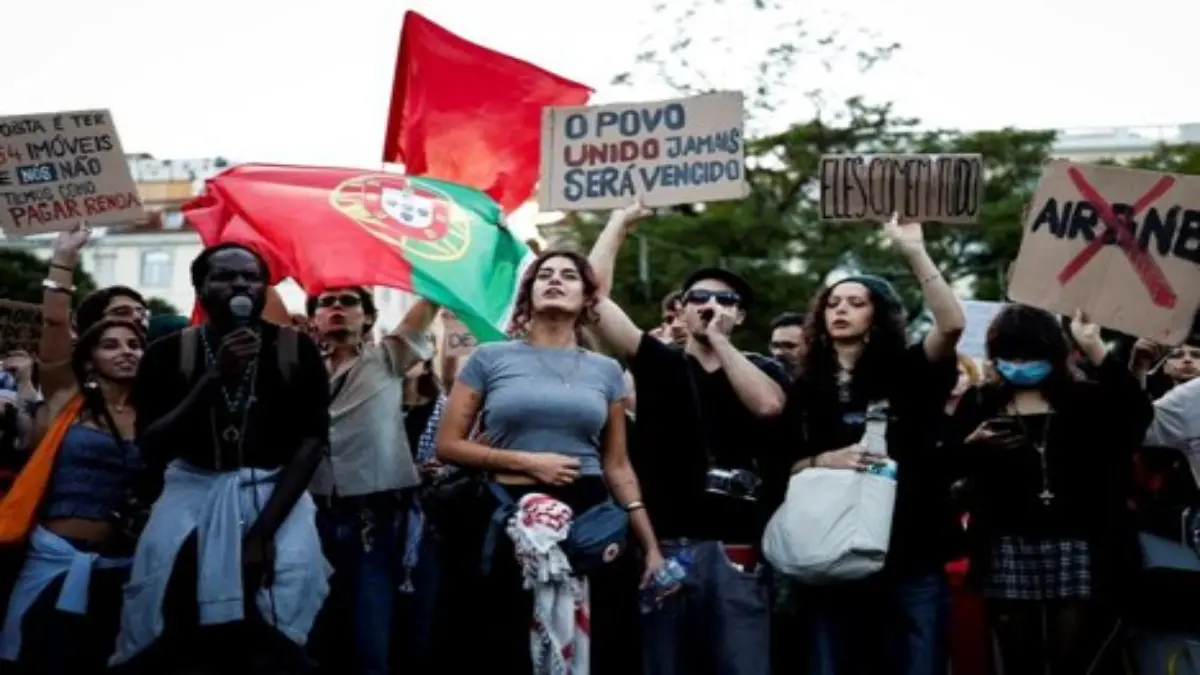
Protests are sweeping across Europe, with hundreds of thousands of people taking to the streets in dozens of cities across the continent. The protests have a background.
Geopolitics and geo-economic scenario in the world is in a flux at present and the governments world over are struggling to meet the most basic aspirations of their citizens due to misdirected domestic priorities on one hand and global uncertainties on the other. The uncertainties caused by Russia -Ukraine war and US-Israel-Iran war have increased the cost of living in many countries due to hike in energy prices caused by disruptions in energy supply chains. The shrinking development expenditure following slow growth and post COVID economic recovery has increased discontent among people. Many countries are facing increased unemployment and reduced public expenditure on social overheads like schools and hospitals and ageing and poor infrastructure including roads, bridges and water supply systems have added to rising public discontent overtime.
Although there are some shared grievances such as increasing cost of living, there are differences in the main reasons of unrest in six countries in Europe. The first demonstrations started in France last month and, since then, the protests spread to many countries. The countries which saw protests include France, Italy, Spain, Albania, Portugal, Belgium, Germany and Austria.
France
The demonstrations can be traced back to September 17, when teachers at a high school in south-eastern Paris protested about staffing shortages. Students subsequently joined in, and it did not take long for the unrest to spread to other schools around the country. What started about education has broadened to include general cost-of-living issues and cuts to the public sector. Grassroots groups like Yellow Vest movement revived roadside and fuel-station blockades reminiscent of the 2018 movement to protest high gas and oil prices. Trade unions joined the marches to demand higher wages, higher pensions, and immediate relief from inflation. These protests had a fertile ground at a time of rising inflation and budgetary austerity. Prime Minister Sébastien Lecornu proposed austerity budget in 2027 aimed at narrowing France’s large national deficit (freezing civil service pay indexes and cutting sick leave reimbursements). Some analysts are also pointing towards exhausting esteem of the ruling party while opposition parties are increasing their voices against government’s failures before the next election. Coming near the end of President Emmanuel Macron’s tenure and ahead of the April 2027 presidential elections, opposition parties and citizens have channeled broader political fatigue into the streets.
The gatherings in France became more violent and in some areas, shops were looted and historic buildings were vandalised or even torched. Curfews have been announced in parts of Paris and Lille after some rallies turned violent, with police arresting hundreds amid looting and extensive damage to businesses and public buildings.
Although French President Emmanuel Macron vowed to prevent further violence during ongoing cost-of-living protests, he underscored that peaceful demonstrations regarding high fuel prices and public services must be separated from criminal elements. He declared his intent to stop those who “cause chaos”. Speaking from Qatar, Macron criticized foreign officials for allegedly exploiting the riots to campaign for domestic politics without proof. He also condemned comments from foreign leaders—including U.S. President Donald Trump and Israeli Prime Minister Benjamin Netanyahu—as “stupid” and “unacceptable”. Following weekend riots that led to nearly 2,400 arrests and widespread looting, Macron pledged a massive police and security deployment ahead of upcoming rallies planned by student unions and Yellow Vest groups.
Albania
Anti-government protests in Albania—led by the grassroots “Flamingo Revolution” and joined by students—have erupted into violent clashes in Tirana. Beginning in mid-2025 and stretching through the summer of 2026, thousands of Albanians gathered nightly in Tirana calling for Prime Minister Edi Rama to step down, citing widespread corruption allegations, a controversial luxury coastal resort project linked to Jared Kushner, poor education standards, and a high cost of living.
Public anger initially sparked over government-approved luxury tourism plans on protected southern coastal sites like Zvërnec and Sazan Island, tied to an investment firm founded by Jared Kushner. Activists warned the projects would destroy local habitats (such as flamingo breeding grounds) and strip public land. The other reason of protest was allegations of corruption. Growing scandals and high-value tender controversies involving senior officials in Rama’s Socialist Party government fueled a wider push for accountability.
The protest was also fueled by high inflation, rising housing costs, limited job prospects, and poor university and school conditions which drove high school and university students into daily street demonstrations. In October 2026, protests turned violent as students and masked demonstrators clashed with riot police outside the Ministry of Education and other government buildings. Protesters hurled rocks and petrol bombs while police deployed tear gas, water cannons, and rubber bullets.
However, Prime Minister Edi Rama has refused to resign, framing the unrest as a “hybrid war” exploiting genuine economic hardships while condemning violence from extremist elements and minors. Opposition figures like Democratic Party leader Sali Berisha have praised the student-led actions.
Italy
Italy is also witnessing widespread protests mainly driven by soaring living costs, low wages, high inflation, gas price hikes, and public service cuts, alongside parallel blockades by farmers and truckers in the south over fuel prices. In response to subsequent riots and looting, Prime Minister Giorgia Meloni’s government approved strict security decrees.
In different regions of the country protestors have similar but different reasons. Demonstrators in northern cities like Milan, Turin, and Bologna have marched against stagnant wages, high inflation, and steep grocery and utility prices. On the other hand farmers and transport workers in southern Italy have blockaded major highways and ports, citing soaring fuel prices worsened by international conflicts that squeeze their profit margins. Another important group of protestors include unions and citizens who have protested government austerity measures and reductions in public funding, with general strikes organized by groups like the CGIL.
What began as cost-of-living demonstrations in mid-October 2026 turned violent in cities like Milan, where masked groups clashed with police, looted shops, and set fires. Prime Minister Meloni’s cabinet responded with an emergency decree deploying 500 additional troops to Milan, establishing prison sentences of up to five years for violent protesters, introducing heavy fines, and holding parents financially liable for vandalism committed by minors. However, civil rights groups and opposition figures have warned that the sweeping decrees threaten the freedom to demonstrate and risk criminalizing dissent.
Greece
Greece is witnessing protests involving thousands of students, teachers, and civil servants marching through Athens, Thessaloniki, and other cities over soaring living costs, high urban rents, and education funding shortages. The demonstrations coincide with broader European labor strikes and follow a legacy of social unrest linked to long-term economic pressures.
One of the most important factors behind the protests is skyrocketing rent prices and inflation leaving many students and young workers priced out of urban housing, with government rent subsidies considered inadequate. Added to this is shortage in education funding and staffing.Teachers and university students are striking over underfunded public schools, staff shortages, and the deteriorating condition of classrooms. Another factor is anger aginst stagnant wages. It is notable that despite post-debt-crisis economic growth, real purchasing power remains low, and average salaries struggle to keep pace with basic expenses. Added to protestors are labour unions. Unions are demanding the full reinstatement of collective bargaining rights that were stripped away during the 2009–2018 financial bailout era.
There is also historical context of protests in Greece traced back to austerity movement during 2010-12 during Eurozone debt crisis (Euro 110) leading to massive cuts in public spending, pensions and hike in taxes. Students were also angree on Kerameus-Chrisochoidis Law (2021) allowing police on university grounds. Government was also criticized for poor governance, especially after2023 head-on train collision in Tempi on the allegation of poor railway safety standards, institutional accountability, and slow trial proceedings. There was marked effect of Europe wide student movements and labour movements as well.
Portugal
Portugal is currently experiencing a wave of massive, nationwide protests. Tens of thousands of citizens, led by youth activist groups and the country’s largest trade union, the General Confederation of Portuguese Workers (CGTP), have taken to the streets in major urban centers like Lisbon, Porto, and Coimbra. The unrest recently escalated into sit-ins and the establishment of large tent camps in iconic public squares, such as Lisbon’s Rossio Square and Porto’s Dom João I Square. Tensions peaked after coordinated pre-dawn police operations forcibly dismantled these camps and arrested dozens of activists, triggering fresh waves of demonstrations.
The main causes of protests included deepening housing affordability crisis, skyrocketing property prices and costs, influx of real estate foreign investors displacing locals from neighbourhoods, stagnating wages and rising cost of living besides a controversial housing legislation. The primary driver of the unrest is an unprecedented housing squeeze, which is currently recorded as one of the worst in Europe. Property purchase prices in Portugal have more than doubled since 2017, and rents for new leases have nearly doubled over the same timeframe. In Lisbon, the average rent has surged so heavily that it actually surpasses the average local salary. Added to the problem is pricing out of long-time residents out of their neighborhoods due to an influx of foreign real estate investors, heavy tourism, short-term vacation rentals, and high-earning remote workers (“digital nomads”). To cap it all stagnant wages and rising inflation have added fuel to the fire. Portugal remains one of Western Europe’s lower-wage economies. Protesters argue that local salaries are fundamentally failing to keep pace with basic survival costs. Driven by rising food prices and a 15% spike in year-on-year fuel costs, Portugal’s inflation rate sat at 3.6% in September. With over half of the country’s workforce earning less than €1,000 a month, everyday expenses have become unmanageable.
Further public is angry over a new bill proposed by the center-right government of Prime Minister Luís Montenegro. The legislation, which recently passed its first parliamentary reading, intends to deregulate the market to boost supply. However, housing rights groups are demanding its immediate withdrawal because it makes evictions easier and removes rent caps on new leases.
The movement gained massive momentum and public sympathy following what activists described as heavy-handed police tactics. Evictions of tent cities in Porto and Lisbon left dozens of peaceful protesters injured and led to 55 arrests, fueling a collective sentiment of “enough is enough” across generations.
Belgium
Recent protests in Belgium—primarily concentrated in French-speaking regions like Brussels and Liège through October 2026—stem from a combination of government austerity cuts, rising higher education costs, and broader economic grievances. The unrest has led to widespread clashes, property damage, and nearly 200 arrests.
The primary driver of protest is austerity and budget cut measures. Federal plans targeting roughly €300 million in public savings have triggered intense pushback, including a major trade union-backed strike of 30,000 people in Brussels. Added to this grievance is rising cost of education and lackadaisical approach to education reforms. French-speaking high school and university students are protesting rising tuition fees, reduced study resources, and teacher workload changes (such as mandatory extra hours without pay), partly inspired by parallel student movements in France.
However like most protests, the protests in Belgium also have spillover effects. Peaceful union marches and student demonstrations have repeatedly been joined or hijacked by rioters, leading to barricades, fires, and vandalism. Early in the month of October, massive protests (30,000-50,000 protestors) over austerity measures took place student rallies also erupted in Liège over education funding and resource shortages. Many protestors were detained across initial days. Subsequently by mid Octobe student and youth protests escalated in Brussels and Liège and turned violent. Police arrested many protestors.
In the final assessment all the governments of the countries where recent protests were seen and stll continuing have failed to meet common people’s aspirations while rising inflation and cost of living have made life much difficult. The governments are constrained to spend money due to low growth and revenue collection while they have chosen to divert a major share of public expenditure to the areas which have less to do for meeting public’s basic needs like education and housing. The political unrest is brewing across Europe and in coming times it may intensify if people’s aspirations are not made. It is not the elegance of promises and governments’ advertisement and propaganda that satisfy people, but the real improvements leading to good and affordable life, efficient public services and measures to alleviate corruption.