
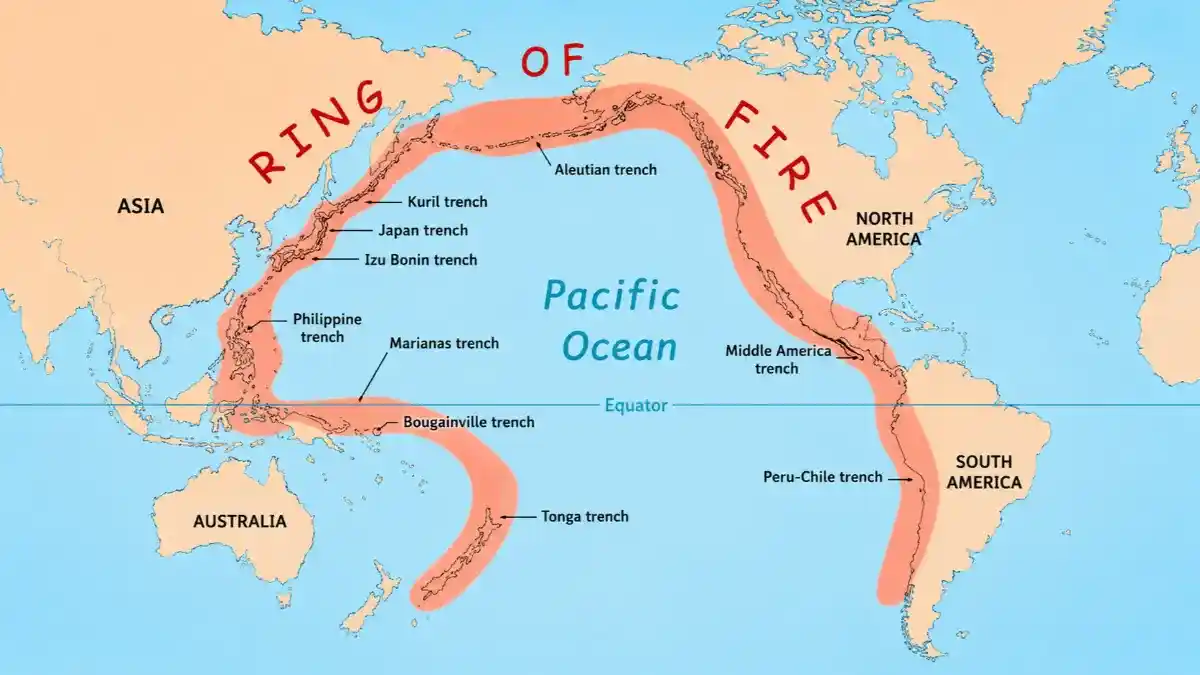
Recently three countries, viz, Venezuela, Columbia and Indonesia were stricken by massive earthquakes. They faced huge damage to property and infrastructure and loss of life. While Venezuela is not under the Circum -Pacific Seismic belt, Columbia and Indonesia are under it. The circum-Pacific Ring of Fire is the worlds most seismically and volcanically active zone. It exists largely because the Pacific Plate meets and interacts with several surrounding plates. About 81 per cent of the world’s largest earthquakes occur along the circum-Pacific seismic belt, according to the USGS. Many are generated at subduction zones, where one tectonic plate sinks beneath another. However, analysts point out that close timing of these earthquakes does not by itself mean they are connected or that the entire Ring of Fire has suddenly become more active.
The natural disasters lead to loss of life and property in all the places where they strike irrespective of the economic stature of the country, but the relatively poor countries lack a system of their own to respond in a timely manner to save life and provide its citizens with essential requirements of life like shelter, food and medicines.
Venezuela
Venezuela was stricken by two high magnitude earthquakes reading 7.2 and 7.5 on the richter scale on June 24, with the coastal state of La Guaira and the national capital, Caracas, hit the hardest. The Venezuelan government confirmed death toll of 6,125 people from a pair of heavy earthquakes that struck the country in June. The government , headed by interim President Delcy Rodriguez, faced mounting criticism for shortcomings in the government’s response to the deadly earthquakes.
Although, the government tried hard to remove the debris, its pace was very slow. The country’s progress on the path to recovery also remained inadequate. Notably, a report from the World Bank has placed the physical damage from the earthquakes at nearly $20 billion. Despite pledges of support from countries around the world in the days following the earthquake, it remains unclear where such funds might come from. Apart from deficiencies of its own in Venezuella, the government -led efforts were also constrained by sanctions imposed on the country by the US.
The United States has maintained a high degree of control over Venezuela since abducting former President Nicolas Maduro in a military raid in January, and some US economic sanctions from Maduro’s tenure in office remain in place. Advocates have called for the remaining sanctions to be loosened or cancelled to help facilitate the flow of funds into Venezuela.
Columbia
A magnitude 7.4 quake struck Columbia at a depth of 103km (64 miles) in Chocó province on August 11. It was felt across an enormous area, stretching for hundreds of miles across western Colombia. At least 169 people are dead and a state of emergency has been declared after Colombia was hit by one of its largest earthquakes in years.It was conjectured that the
death toll may rise, with more feared trapped under collapsed buildings.
Many of the deaths have been concentrated in Cali, Colombia’s third most populous city. At least 900 people were injured in the quakes,
The epicentre of the quake was near the village of San José del Palmar, in Chocó province, but local mayor León Fabio Marín Moncada said that there had miraculously been no deaths or injuries – despite the roads in and out being damaged.According to Asocapitales, most of the fatalities where in cities.Cali, located about 200km from the epicentre, was the worst affected with 85 dead.
President Abelardo de la Espriella announced a special emergency fund dedicated to rebuilding destroyed public infrastructure, including schools and hospitals. Authorities and the UN Development Programme (UNDP) deployed satellite imagery to map population exposure and assess building damage in hard-hit cities like Quibdó, Cali, Pereira, and Manizales. The World Food Programme (WFP) and UNICEF distributed food packets, family hygiene kits, and mobile storage units to support displaced families in Quibdó and surrounding areas. The International Organization for Migration (IOM) and the International Rescue Committee (IRC) coordinated mental health support, health response capacities, and child protection services to mitigate trafficking and exploitation risks in vulnerable regions.
Colombia is Latin America’s fourth-largest economy with a GDP of roughly USD 400 billion. Growth is expected to moderate to around 2.4%–2.7%. Colombia’s economy is stabilizing with moderate growth projected around 2.4% to 2.7% for 2026, driven by household consumption and a strong services sector The earthquake would make things difficult for the government. Although the national unemployment rate improved to around 8.0%, aided by job recovery in manufacturing, construction, and public services, moderation of economic growth may put additional pressure. Although, the country hss maintained the annual inflation stable at about 5.68%, it is still grappling with sticky services inflation and energy pressures which keep monetary conditions tight as the central bank manages interest rates. The country is already facing structural challenges. High labor informality affects over half of the workforce, and income inequality remains among the highest in the region. Business investment has remained subdued since the end of the prior commodity boom, and persistent fiscal deficits create ongoing macroeconomic and policy debates under the current administration.
Indonesia
A powerful earthquake of magnitude 7.7 hit the coast of Indonesia early on August 15 and killed at least 47 people, triggering a brief tsunami warning and a series of aftershocks, according to the nation’s geophysics agency BMKG. The quake hit off the Coast of Flores Island at roughly 6 a.m. local time on Saturday, 42 miles (68 kilometers) northwest of the coastal town of Ende at a depth of about 6 miles (10 kilometers), according to the U.S. Geological Survey (USGS). Residents in coastal parts of Flores island were urged to leave the area immediately and move to higher ground. The death toll was likely to increase as several people were reported injured to varying degrees and rescue operations continued after.hundreds of buildings in the region were damaged by the quake and dozens of aftershocks that followed. Landslides and communication disruptions that followed hampered access to areas around Nagekeo and other parts of Flores. More than 150 homes were destroyed or flattened, while schools, health facilities and other public buildings were also damaged.
Natural disasters are both man-made and natural in nature. For man- made natural disasters, blind race for development is responsible. Development in all the regions should not be based on the principle of ‘one size fits all’ but it should take into consideration the nature of terrain and topography of a region to find a suitable model of development for it. The disasters caused by natural phenomena like plate tectonics are not under human control, but disaster preparedness can help weather such crisis and recover from it in soonest possible time.