
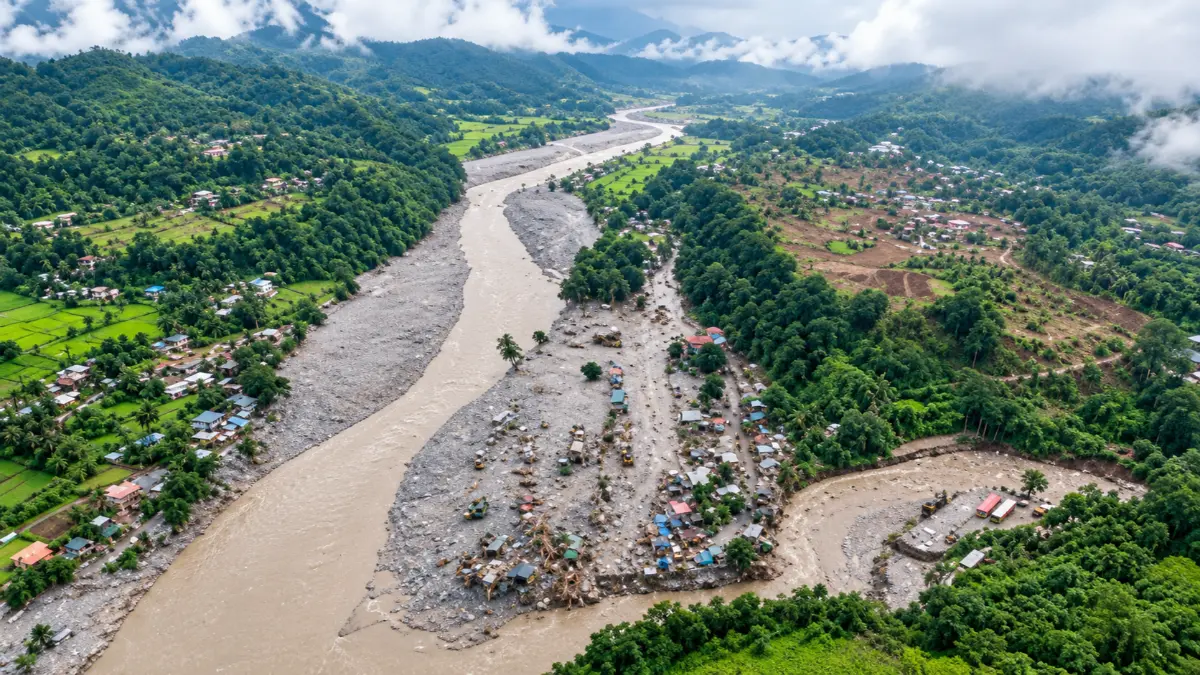
Nepal’s recent recent catastrophic flash floods occurred on August 26, 2026 due to a massive ice and rock avalanche/glacier collapse on Langtang Lirung near the Nepal-Tibet border that surged down the Bhotekoshi and Trishuli river valleys. The floods extended downstream along the Trishuli River valley in Nepal and extended into parts of Tibet and India. The devastating floods affected the Gyirong checkpoint on the China-Nepal border and settlements along a 72-km stretch of the Trishuli River in Nepal. High-risk floodwaters and debris also impacted the Tibet Autonomous Region. The regional spread of devastation was also unprecedented as bodies of dead victims were swept downstream into districts (such as Kushinagar and Maharajganj) of Indian state of Uttar Pradesh.
Although initially the floods were supposed to be caused by a massive seismic movement near China-Nepal border, later it was confirmed by the scientists from the International Centre for Integrated Mountain Development (ICIMOD) and partner institutions in Nepal and China to have been triggered by an ice-rock avalanche originating from a high-altitude area. According to preliminary assessments, a large volume of ice and rock debris that entered the Lende Khola, a tributary of the Bhote Koshi River, generated a sudden surge that carried water, sediment and large boulders downstream. The debris also caused blockage on river on the upper tracts and authorities warned that the blockage lodged upstream on the Nepal-China border could cause a second flood and passed evacuation orders. According to data from hydrological observations the flood waves had exceptional speed and magnitude, Water levels on the Trishuli River at Galchchi reportedly rose by as much as nine metres within 30 minutes, while levels at Malekhu increased by seven metres over a similar period.
Estimates of damage
Although Nepal was able to recover successfully 843 bodies earlier, the death toll due to the devastating flash floods rose to 1,344 on September 5, 2026 as more bodies were recovered from the affected areas while thousands remain missing, The flood has caused significant damage to infrastructure in the affected areas, including hydrological monitoring stations and several hydropower facilities located along the Bhote Koshi River and connected river systems. According to Dharma Raj Upreti, chief of the National Disaster Risk Reduction and Management Authority, property, housing and infrastructure worth at least 387.5 billion Nepalese rupees ($2.56 billion) was lost in Nepal’s catastrophic floods. It was also estimated that in the first four months of early recovery, the estimated cost to build roads and temporary shelters, provide drinking water and restore power would be around $52.6 million. For a low income country like Nepal the estimated cost of recovery and rebuilding is likely to cause a lots of economic pressure, However, Nepal’s two big neighbouring countries and multilateral financial institutions have come forward to help Nepal.
International assistance to Nepal after floods
International assistance and technical rescue teams are actively flowing into Nepal to support recovery operations following the devastating flash floods. India’s response was the most prompt for Nepal which was appreciated by the people of Nepal in general. Here is a list of sources of support and assistance:
- India:Deployed multiple relief flights carrying over 60 tons of supplies (medicines, blankets, and food), an Indian Army tunnel rescue team with specialist equipment, and forensic teams for DNA sample analysis, alongside Bailey bridges to restore transport connectivity.
- China:Dispatched specialized tunnel rescue experts to assist local emergency crews along the border regions. However it did not give any details.
- United States:Increased its humanitarian assistance contribution to $3.6 million to support immediate on-ground needs.
- United Nations & Multilateral Banks:The UN Office for the Coordination of Humanitarian Affairs (OCHA) allocated an initial $2 million from the Central Emergency Response Fund (CERF), while the Asian Development Bank (ADB) announced an immediate $5 million grant and disaster response funds for damage assessments.
Consequences of Nepal Floods for India
india also felt the consequences of the recent devastating Nepal floods as a close neighbor and development partner. As many Indian nationals were among those impacted by the flash floods on both the Nepal side and the China side, Government of India has been working in close coordination with the Nepali and Chinese authorities for the early rescue and relief efforts of those affected by the floods. A round-the-clock Control Room has been established in the Ministry of External Affairs and our Embassies in Kathmandu and Beijing have 24/7 helplines operational. by the end of August, 108 Indian nationals were rescued in Nepal and contact was re-established with around 50 Indian nationals who were earlier uncontactable. Furthermore, 598 Indian nationals safely crossed into Nepal from China by August 29. Around 900 Indian nationals are still on the Chinese side but are safe and contactable. Unfortunately, more than 275 Indian nationals and 128 persons of Indian origin remain missing or non-contactable.
In sum, the recent flash floods in Nepal caused severe loss of life and property. Natural disasters are very painful for those
who lost their family members, livelihood and shelters while for a government of a least developed country like Nepal the pressure of recovery and rebuilding is very high. The location of Nepal and its geography is prone to natural disasters. To minimize the risk and loss the country needs to maintain an early warning system and collaborate with its neighbouring countries. The latest disaster underscores the need for stronger regional collaboration, with governments taking coordinated action to respond to cross-border hazards. The downstream communities need more awareness and facilitation to mitigate the risk of such disasters. Climatic Changes and its effects on glacial topography at high altitude need to be continuously monitored and assessed. Although the link of the current Nepal flood disaster cannot be conclusively related with glacial meltdown by global warming, genuine studies need to be done continuously to understand the problem and find solutions. Scientists have already cautioned that climate change is altering glaciers, snow conditions, permafrost and mountain slopes across the Hindu Kush Himalaya.