
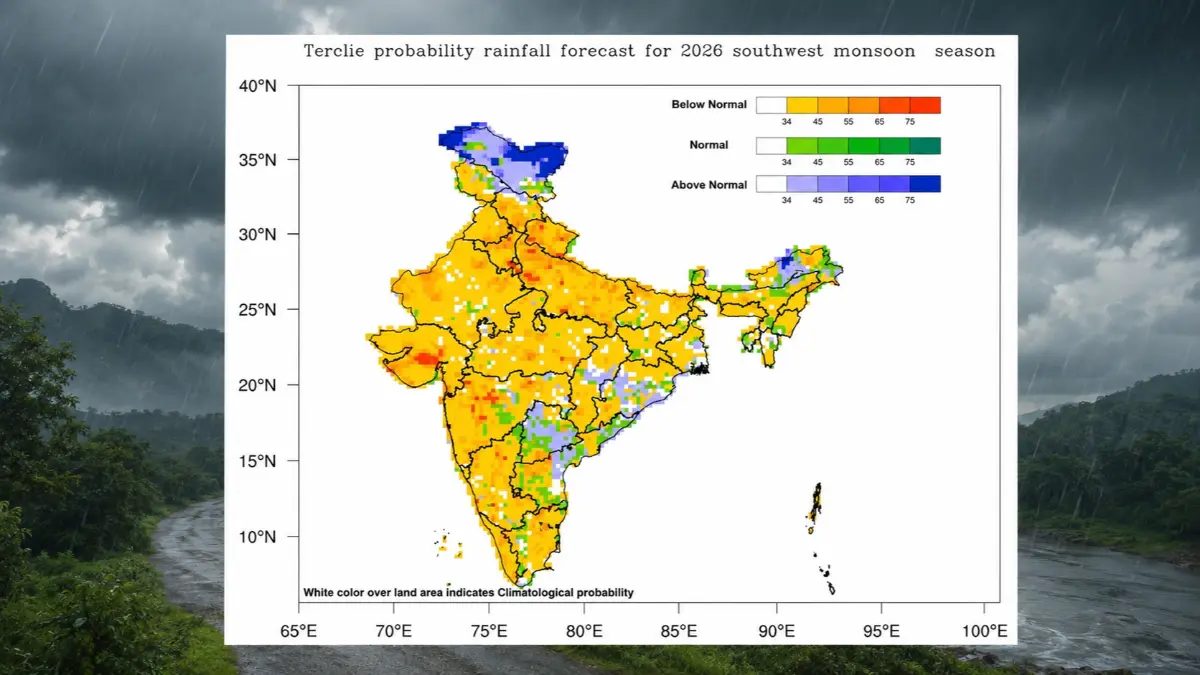
Monsoons play a very important role in Indian Agriculture in particular and life in general. Monsoon refers to a large-scale seasonal change in wind direction that causes major changes in precipitation. Monsoon scientifically describes the physical shift in wind patterns between wet and dry periods. According to wind direction and rainfall cycle in Wet Phase or Summer Monsoon, land heats up faster than the ocean, creating low pressure that pulls moist air inland to drop heavy rainfall. Contrary to it in Dry Phase or Winter Monsoon the land cools faster than the ocean, reversing the wind flow to push dry air from land out toward the sea. Technically El Nino and La Nino play an important role in change of wind direction and precipitation during the Wet and Dry phases of Monsoon.
El Niño and La Niña are opposite phases of the El Niño-Southern Oscillation (ENSO) cycle, representing the warm and cool fluctuations of sea surface temperatures in the equatorial Pacific Ocean. El Niño warms the central-eastern Pacific and weakens trade winds, while La Niña cools it and strengthens trade winds. Weak trade winds resulting from EL Nino push warm water eastward. This disrupts the Walker circulation and cuts off moisture transport to India. it suppresses the southwest monsoon, resulting in below-normal rainfall and delayed onset. Contrarily strong trade winds during La Nino cause cold water upwelling in the eastern Pacific, creating high pressure there and low pressure over Asia. It strengthens the southwest monsoon and increases moisture convergence, bringing normal to above-normal rainfall.
Dryland and rainfed farming account for roughly 52% to 68% of India’s total cultivated and cropped land, spanning about 80 million out of 141–143 million hectares of agricultural land. Estimates range between 52% (narrowly defined dryland) and 67%–68% (broadly rainfed agriculture). This sector contributes about 42% to 44% of the country’s total foodgrains. This sector contributes about 42% to 44% of the country’s total foodgrains..Dryland farming is typically practiced in areas receiving less than 75 cm (750 mm) of annual rainfall. It focuses mainly on Fon hardy, drought-resistant crops like millets (bajra, ragi, jowar), gram, and oilseeds. Taken together, they account for over 90% of pulses, 80% of oilseeds, and 70% of cotton.
The India Meteorological Department (IMD) predicted a below-normal southwest monsoon for 2026, forecasting seasonal rainfall at roughly 90% to 92% of the Long Period Average (LPA). This weaker outlook is primarily driven by transitioning and developing El Niño conditions in the Pacific Ocean, It is observed that India’s monsoon season is growing more erratic, swinging between intense rain bursts and long dry spells. This shifting climate behavior—intensified by climate change and global patterns like El Niño—triggers severe urban flooding, landslides, and infrastructure damage and transport gridlocks across major regions. and states.
State-wise Impact
This year’s Monsoon behavior in India could be summarized as below:
- Assam: The worst-hit state, with a death toll reaching nearly 99, affecting over 155,000 people across 13 districts. Over 10,700 hectares of crop land remain submerged, and thousands are in relief camps.
- Kerala: Heavy rains and landslides caused at least 15 deaths, with seven people reported missing and over 10,000 people sheltered in relief camps.
- Jammu and Kashmir: At least 31 people died following multiple intense cloudbursts and heavy downpours.
- Delhi-NCR: Recorded record-breaking rains, surpassing its monthly average early in August with over 230 mm of rainfall, causing severe urban waterlogging and rising levels in the Yamuna and Hindon rivers.
- Other States: States like Gujarat, Odisha, Rajasthan, and Uttar Pradesh faced heavy downpours, flash floods, and severe disruptions.
Causes of Erratic Monsoons
- Climate Change: Global warming alters atmospheric moisture and circulation.
- El Niño Effects: Shifts ocean temperatures, causing weak overall rain mixed with localized cloudbursts.
- Ocean Warming: High sea temperatures feed intense storms and unpredictable weather shifts.
Factors Behind Severe Flooding
- Unplanned Urbanization: Concrete roads and buildings stop soil from absorbing water.
- Blocked Drains: Plastic waste and silt choke old stormwater systems.
- Encroachment: Buildings on natural wetlands, lakes, and river floodplains block natural water flow.
- Extreme Downpours: Short, intense bursts drop days of rain in a few hours, overwhelming local capacity.