
Why in news
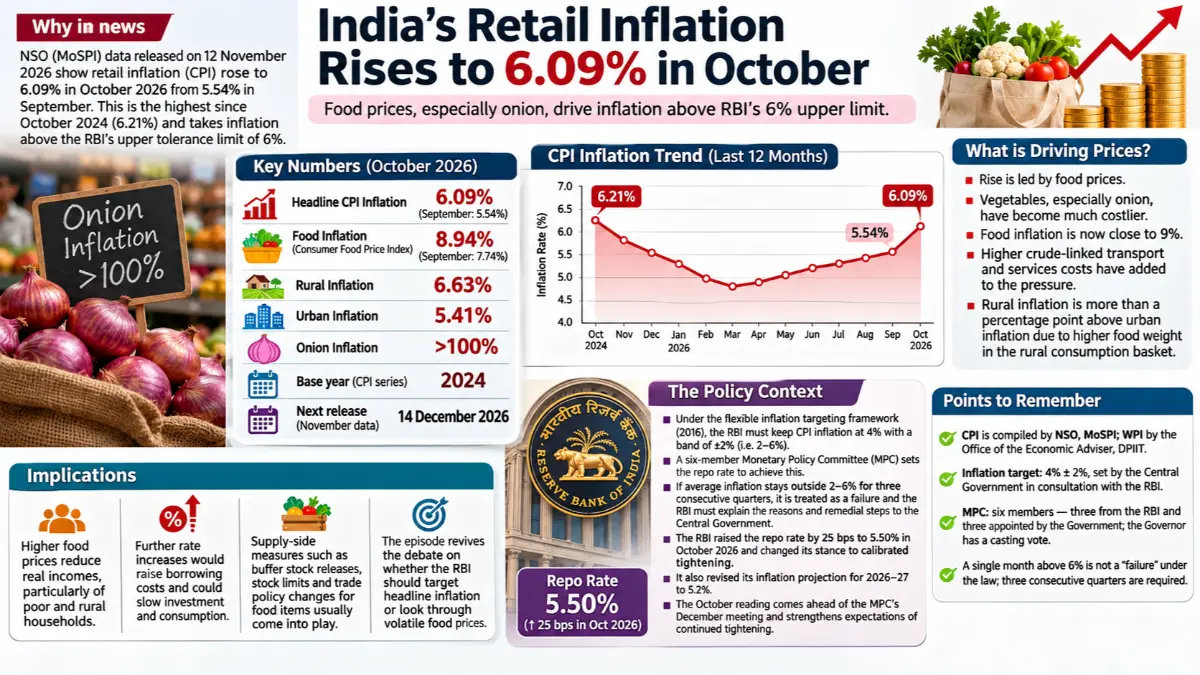
Provisional data released by the National Statistics Office (NSO), Ministry of Statistics and Programme Implementation (MoSPI), on 12 November 2026 show that retail inflation measured by the Consumer Price Index (CPI) rose to 6.09% in October 2026 from 5.54% in September. This is the highest reading since October 2024 (6.21%) and takes inflation above the Reserve Bank of India’s upper tolerance limit of 6%.
Key numbers
- Headline CPI inflation: 6.09% (September: 5.54%)
- Food inflation (Consumer Food Price Index): 8.94% (September: 7.74%)
- Rural inflation: 6.63%; urban inflation: 5.41%
- Onion prices were among the biggest contributors, with inflation above 100%
- Base year of the current CPI series: 2024
- Next release (November data): 14 December 2026
What is driving prices
The rise is led by food. Vegetables, especially onion, have become much costlier, and food inflation has now moved close to 9%. Higher crude-linked transport and services costs have added to the pressure. Rural inflation is more than a percentage point above urban inflation because food has a larger weight in the rural consumption basket.
The policy context
Under the flexible inflation targeting framework, introduced by amending the RBI Act, 1934 in 2016, the RBI has to keep CPI inflation at 4% with a band of plus or minus 2%. The six-member Monetary Policy Committee (MPC) sets the repo rate to achieve this. If average inflation stays outside the 2–6% band for three consecutive quarters, it is treated as a failure and the RBI must explain the reasons and remedial steps to the Central Government.
The RBI had already raised the repo rate by 25 basis points to 5.50% in its October review and changed its stance to calibrated tightening. It had also raised its inflation projection for 2026–27 to 5.2%. The October reading comes ahead of the MPC’s December meeting and strengthens expectations of continued tightening.
Implications
- Higher food prices reduce real incomes, particularly of poor and rural households.
- Further rate increases would raise borrowing costs and could slow investment and consumption.
- Supply-side measures such as buffer stock releases, stock limits and trade policy changes for food items usually come into play, since monetary policy has limited effect on food supply shocks.
- The episode revives the debate on whether the RBI should target headline inflation or look through volatile food prices.
Points to remember
- CPI is compiled by NSO, MoSPI; WPI by the Office of the Economic Adviser, DPIIT
- Inflation target: 4% ± 2%, set by the Central Government in consultation with the RBI
- MPC: six members, three from the RBI and three appointed by the Government; the Governor has a casting vote
- A single month above 6% is not a “failure” under the law; three consecutive quarters are required