
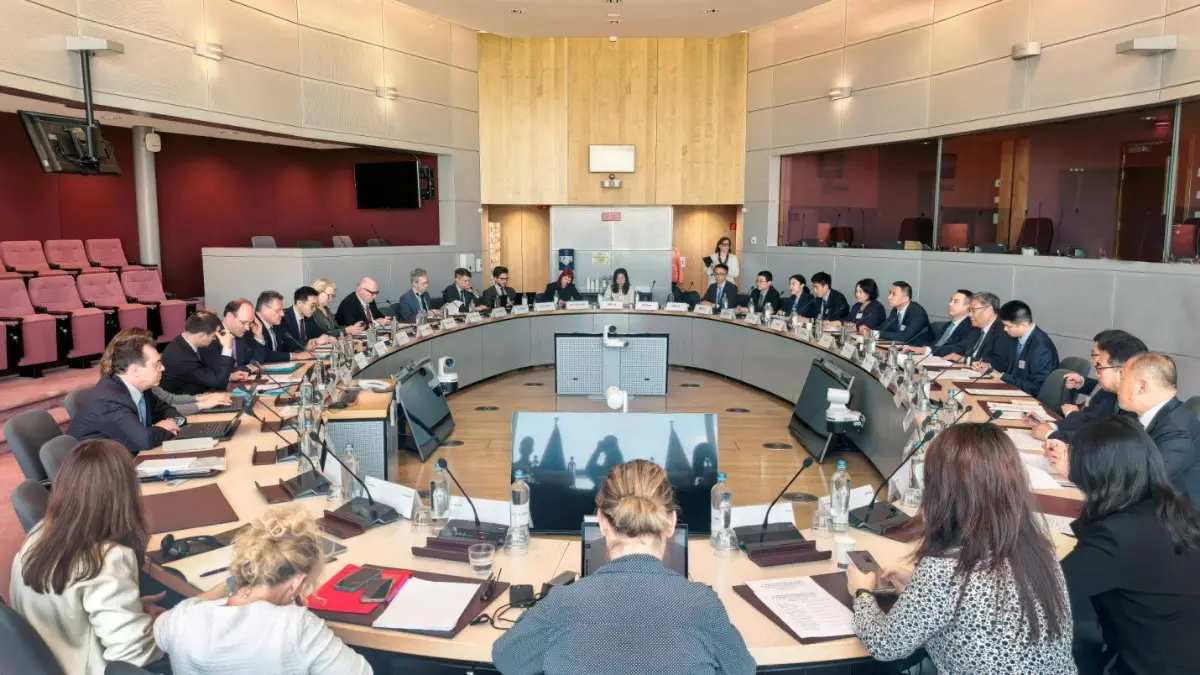
The second meeting of the EU-China Trade and Investment Consultations (TIC) took place on 8–9 October 2026 in Beijing where ), high-level EU-China engagement took place. It was followed by a discussion on trade imbalances at the European Council Summit in Brussels on 15–16 October 2026. In the TIC meeting the measure trade issues discussed pertained to hybrid vehicle trade, EV subsidies, medical devices and market access apart from tariffs and green channel.
Major Outcomes
China and the EU reached a WTO-compliant understanding to moderate and cap exports of Chinese hybrid and plug-in hybrid electric vehicles (PHEVs) to the European Union. Both sides reviewed guidance on corporate price undertakings for battery electric vehicles (BEVs). Further, the two sides agreed to continue dialogues regarding market access for medical devices, pharmaceuticals, and cosmetics. They also explored tariff reductions/eliminations for select goods and discussed green channel facilitation for rare-earth and permanent-magnet exports. The two sides scheduled the third TIC ministerial meeting for March 2027, with a preparatory video-conference set for January 2027. Subsequently in a European Council Summit (Brussels) the EU leaders met on 15–16 October 2026 to follow up and evaluate the preliminary hybrid car deal against a massive goods trade deficit with China (which reached €360 billion in 2025 and continued to widen).
Assessment
The disputes are far from over, but there is some progress. The EU’s headline gain is a ‘shared understanding’ with China on reducing Chinese exports of hybrid and plug-in hybrid-electric vehicles. However, Europe’s bilateral trade deficit with China is €360 billion, and Chinese automotive exports to the EU are worth around €15 billion. Much of the imbalance derives from increasingly large EU imports of machinery, chemicals, metals, solar panels, batteries and ICT products. A marginal reduction in automotive exports will hardly make a difference.
The second ‘shared understanding’ reached is even less impactful: China will lower tariffs on some European products, including car parts, olive oil and footwear, saving some €225 million in duties – again, marginal compared to the overall trade deficit.
The third ‘shared understanding’ is the creation of a ‘green channel’ to facilitate licences for rare earths and permanent magnets. Leaving such an agreement to China’s discretion does not guarantee the provision of rare earths when needed, as Washington and Brussels discovered in October 2025.
Beijing indicates that the softening of export controls must be reciprocal. It will be difficult for both the sides to grant softening of export controls without resolving their differences in economic and security perceptions. China will resist questioning on its state subsidies to its EVs sector and cybersecurity risk regarding solar inverters while the EU will not find it easy to relax export controls on dual-use sectors such as advanced lithography, a critical component for advanced AI chips. It is also felt by some analysts that Beijing also secured a technical dialogue on the EU Foreign Subsidies Regulation (Regulation (EU) 2022/2560), which can be deployed to block or penalise foreign companies which receive trade-distorting state subsidies. This is one of the key tools the EU has to protect the single market from Chinese subsidies. Additionally, China also managed to reopen the EU’s block on the use of solar inverters in EU-funded projects, put in place due to cybersecurity risks from certain ‘high-risk’ suppliers (mainly Chinese companies). Analysts wonder whether the EU received more than it gave. It got trade relief in one sector and goodwill on rare earth exports. But China still has the opportunity to up the pressure on technology controls, subsidy screening and cybersecurity measures.