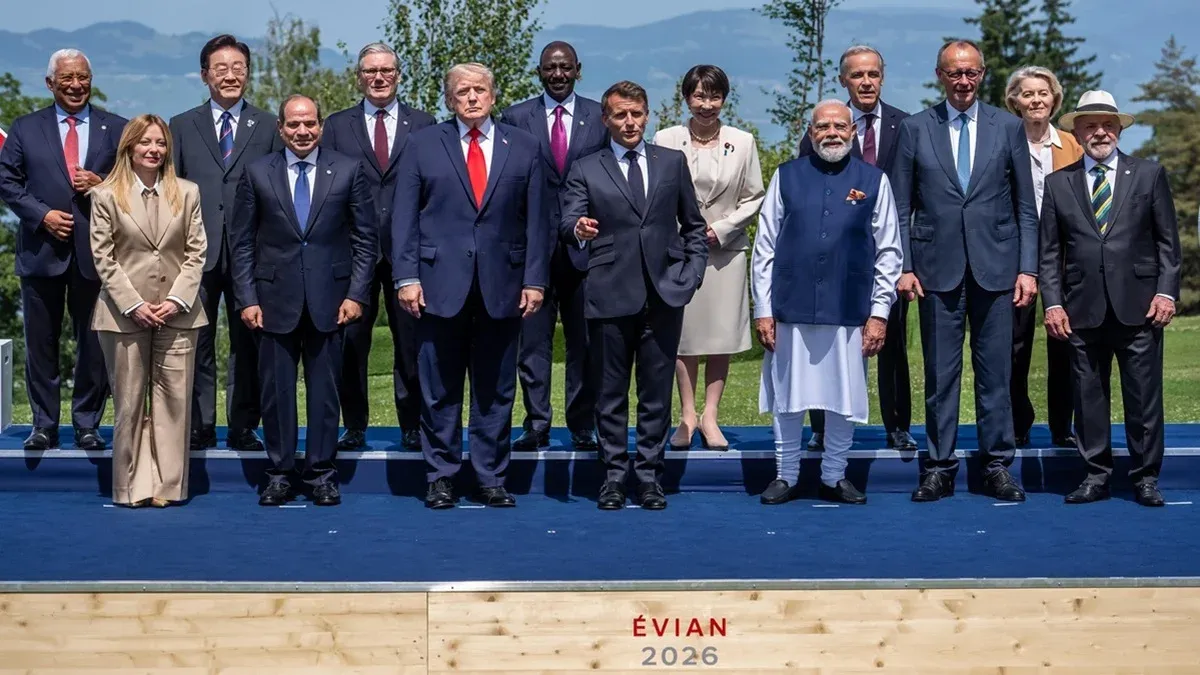
The 2026 G-7 Summit was held in Évian-les-Bains, France. The Summit assumed extra importance due to ongoing turbulent geo-political and geo-economic developments. The control of United Nations on global developments has been substantially weakened, multilateralism is facing irreconciliable differences and international laws and conventions are frequently violated by powerful countries. In such an environment, the role and responsibilities of advanced nations has increased. The G7 (Group of Seven) is an informal forum of leading industrialized democracies—the United States, Canada, France, Germany, Italy, Japan, and the United Kingdom. The European Union (EU) also participates as a non-enumerated member. The present global order is being marked more by divergence instead of convergence on various global issues which is threatening global cooperation and peace. The G- 7 Summit 2026 as expected tried to develop consensus onperplexing global issues.
The Summit mainly focused on global macroeconomic imbalances and ongoing geopolitical conflicts. The leaders adopted several key joint declarations, including strengthened military and energy support for Ukraine, a preliminary US-Iran de-escalation deal, frameworks for AI governance, and strategies to secure critical mineral supply chains. In sum, The G7 Summit sought a coordinated response to international crises and reaffirmed partners’ unity on several major issues
The Summit was remarkably different from earlier ones in more than one way. First, France in an unprecedented move, involved partner countries (India, Kenya, South Korea, Brazil, Egypt) throughout the discussions, because today’s major challenges can only be effectively addressed together. civil society and the private tech sector were also engaged, as this is essential for effective exchanges on issues of digital and AI regulation and innovation.
Specific outcomes
- Ukraine: G-7 leaders reaffirmed unwavering support for Ukraine’s sovereignty, promising increased military and air defense capabilities, and committed to stricter sanctions on Russian oil and gas.
- Middle East & Lebanon: Members endorsed a preliminary US-Iran deal to reopen the Strait of Hormuz, and called for an immediate ceasefire in Lebanon, demanding the disarmament of Hezbollah.
- Economy & Trade: A joint focus was placed on balanced, durable economic growth and reducing dependencies on specific countries for critical materials and semiconductor supply chains.
- Global Outreach: During the outreach sessions, India championed the priorities of the Global South, emphasizing the reduction of the “global trust deficit” and pushing for more equitable global governance.
- Additional Declarations: World leaders released targeted statements on combating drug trafficking, tackling migrant smuggling, fighting cancer, creating a safer digital space for minors online, and coordinating a response to the Ebola outbreak.
Generally such Summits raise lots of hope, but when it comes to implementation of the agreed points their execution faces lots of constraints due to lack of political will, flexibiloity and trust. A global order based on copperation and a strong commitment for peace and prosperity from all the advanced nations can help confronting the present crises facing the world effectively.