
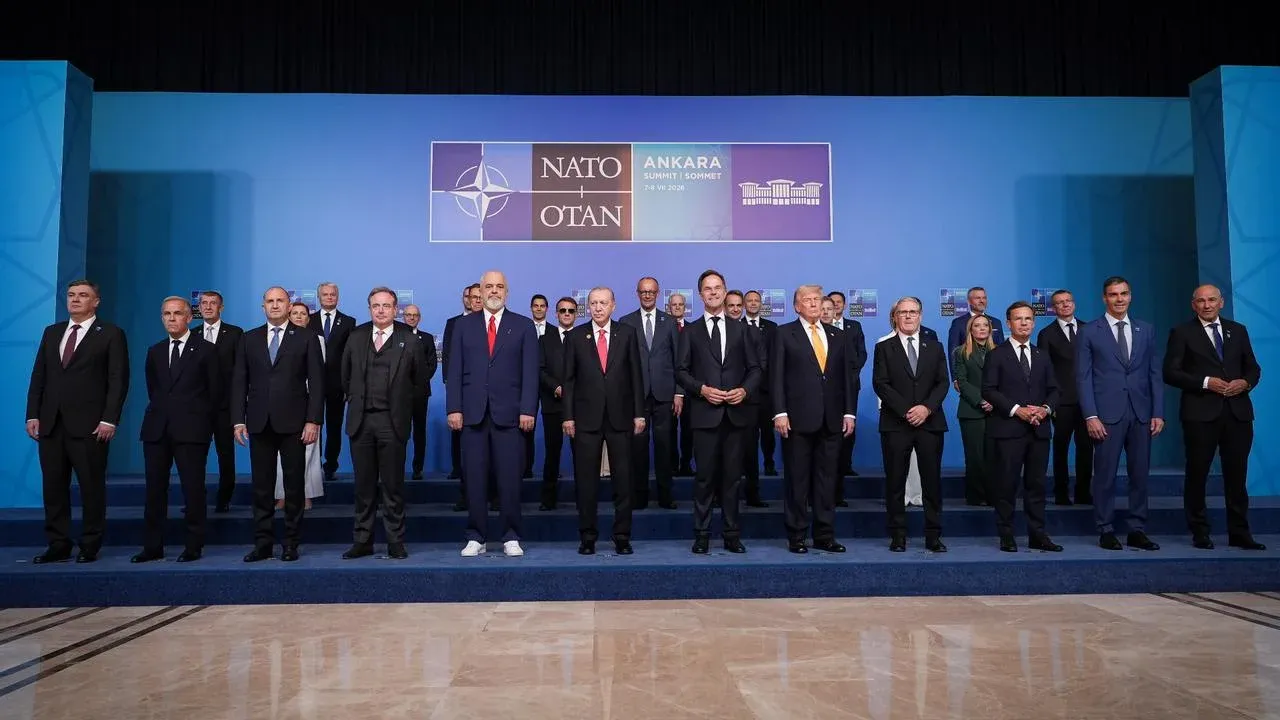
The 36th NATO Summit was successfully hosted by Türkiye in Ankara on July 7–8, 2026. It was second time the country has hosted a NATO summit. It was held at the Presidential Complex. NATO, the North Atlantic Treaty Organization is an intergovernmental military alliance comprised of 32 member states from North America and Europe. Amid ontinuing Ukraine-Russia conflict and US-Israel-Iran war the US has been continuously urging the member countries to raise their defenxe expenditure to 5% of GDP and contribute collectively in increasing the group’s defense capacity building. As the member countries are still struggling to realise post-Covid sustained economic recovery, the proposal of raising their defense expenditure from their present level of 2-3% of their GDP seems difficult..
The summit was attended by NATO Heads of State, including US President Donald Trump and NATO Secretary General Mark Rutte, alongside key partner nations and the European Union. Ukrainian President Volodymyr Zelenskyy was also present to discuss the ongoing conflict with Russia. Despite past statements of US president about exiting the NATO alliance for lck of collective commitments, especially in bearing the expenses and acting together when US enters in wars for a common cause (which is often not so), the members reaffirmed their commitment to mutual defense
The NATO Summit Defence Industry Forum 2026 was also convened which focused on allied progress toward NATO’s defence investment goals and strategies to boost joint procurement and space capabilities.
Key Outcomes and Agreements:
- Major Defense Procurements: Allies agreed to more than $50 billion in new defense contracts, prioritizing deep precision strike, integrated air defense, and uncrewed systems. A new Strategy for Industry-NATO Cooperation was adopted to accelerate private investment and scale-up innovation.
- Long-Term Aid for Ukraine: Members solidified a historic €70 billion commitment in military assistance and training for 2026, and pledged to sustain at least equivalent levels of financial and military support in 2027.
- Defense Expenditure Review: The summit reviewed progress toward an ambitious 5% defense investment plan (aiming for 3.5% on core defense and 1.5% on related security investments), with multiple European nations accelerating their military budgets.
- Digital & Fuel Infrastructure: NATO approved a EUR 27 billion infrastructure investment to modernize fuel supply chains, and established plans for an interoperable transatlantic warfighting cloud using artificial intelligence.
- US-Turkey Relations: Hosting the summit allowed Türkiye to highlight its expanding defense industry, with the U.S. moving to consider Ankara’s reentry into the F-35 fighter jet program.
The world has drastically changed in the last three decades and the interest of NATO countries today do not always converge. Though NATO is led by the US, other members also have their own national interests including diplomatic and economic relations. Although the alliance is still taken as necessary by the members for security cooperation, there are occasions when all the members find it difficult to support US hegemonistic adventures. Russia and China are common adversaries but the later is not participating in any direct war. The increasing war budgets are also being seen critically by many experts at a time when there are more pressing needs for sustainable development and removal of poverty and disease. NATO is also suggested by many analysts to orient its activities more towards peaceful resolution of the global disputes rather than just using power.