
Why in news
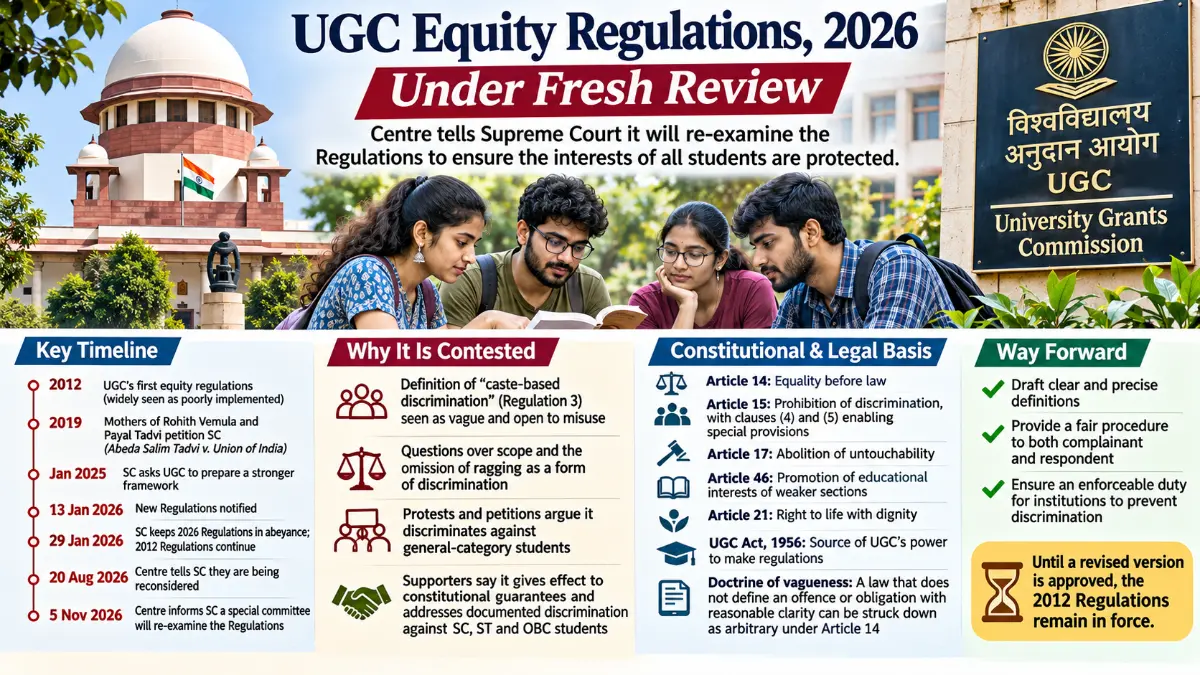
On 5 November 2026 the Central Government informed the Supreme Court that a special committee would re-examine the University Grants Commission (Promotion of Equity in Higher Education Institutions) Regulations, 2026. The Court has stressed that the interests of all students must be protected.
Background
- 2012: the UGC framed its first equity regulations for higher education institutions, which were widely seen as poorly implemented.
- 2019: the mothers of Rohith Vemula and Payal Tadvi petitioned the Supreme Court for an effective mechanism against caste-based discrimination on campuses (Abeda Salim Tadvi v. Union of India).
- January 2025: the Court asked the UGC to prepare a stronger framework.
- 13 January 2026: the new Regulations were notified.
- 29 January 2026: a bench headed by Chief Justice Surya Kant kept the 2026 Regulations in abeyance and directed that the 2012 Regulations would continue.
- 20 August 2026: the Centre told the Court that the Regulations were being reconsidered.
Why the Regulations are contested
The Regulations were followed by protests and by petitions arguing that they discriminate against students of the general category. A central objection is to the definition of “caste-based discrimination” in Regulation 3. The Supreme Court observed that the Regulations appeared “prima facie vague” and capable of misuse, and suggested that the language be reworked. It also raised questions about their scope and about the omission of ragging as a form of discrimination.
Supporters of the Regulations argue that they only give effect to constitutional guarantees and respond to documented cases of discrimination against students from the Scheduled Castes, Scheduled Tribes and Other Backward Classes, and that the earlier 2012 framework failed for want of enforcement.
Constitutional and legal dimensions
- Article 14: equality before law; Article 15: prohibition of discrimination, with clauses (4) and (5) enabling special provisions
- Article 17: abolition of untouchability; Article 46: promotion of educational interests of weaker sections
- Article 21: right to life with dignity
- UGC Act, 1956: the source of the UGC’s power to make regulations
- Doctrine of vagueness: a law that does not define an offence or obligation with reasonable clarity can be struck down as arbitrary under Article 14
Way forward
The task before the committee is to draft a framework that is precise in its definitions, provides fair procedure to both complainant and respondent, and still gives institutions an enforceable duty to prevent discrimination. Until a revised version is approved, the 2012 Regulations remain in force.